
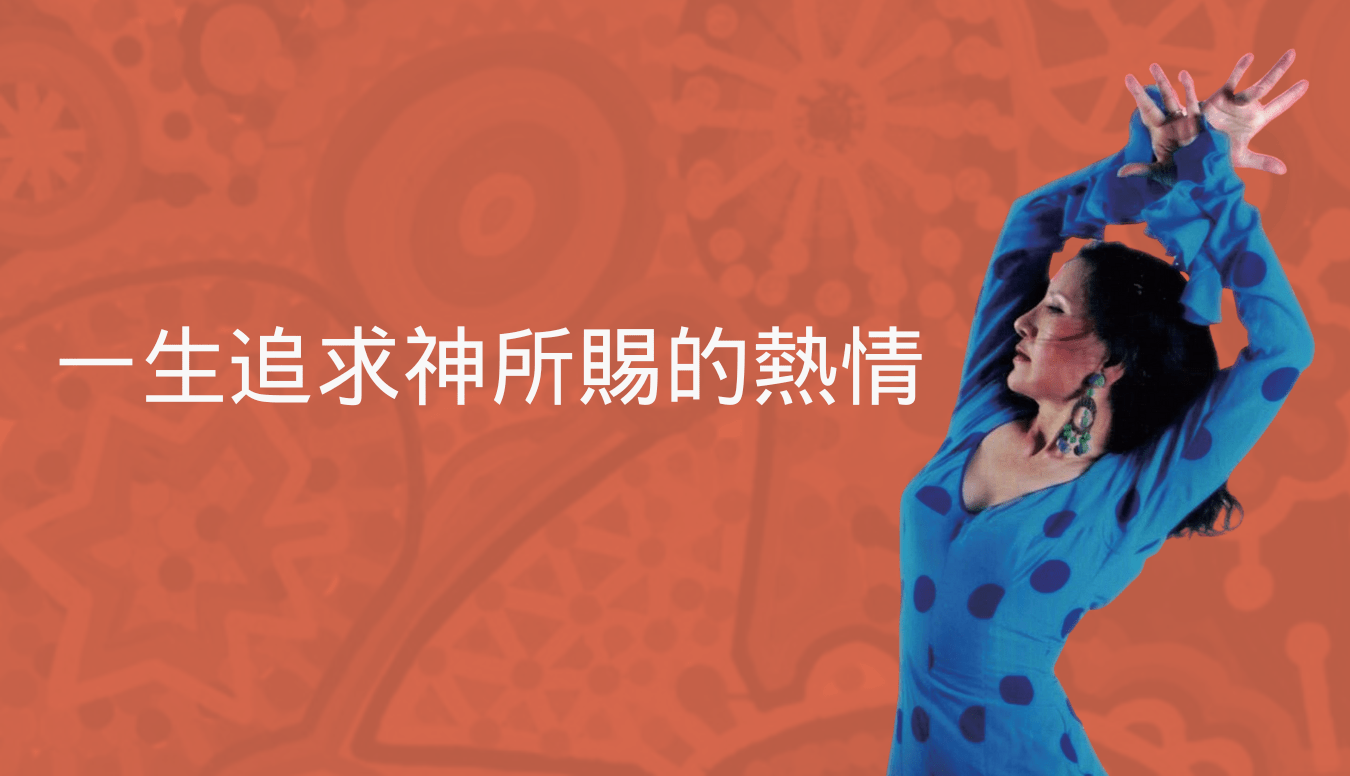
A Lifelong Pursuit of God-Given Passion

Interviewee, Photo Courtesy of Jenny Chang
Interview/Lily Yang, Sherry Lee
Organizing/Sherry Lee
Performance runs through her veins; beauty radiates from her everyday life. Whatever she does, wherever she goes, she finds a stage. For flamenco dance teacher Jenny Chang, life itself has been a lifelong pursuit of the passion bestowed by God.
Da-dum-dum, da-dum, dum, da-dum-dum, dum, da-dum-dum, dum—
A crimson-and-black ruffled skirt sways, black high heels glisten, and the dancer stamps in rhythm with the drums and guitar, her hairpiece trembling with each move. A glance back, a sudden turn; a sharp clap, an outstretched arm—grace intertwined with power.
The art of Flamenco embodies both softness and strength, sorrow and joy, its lively rhythms flowing yet punctuated with sudden pauses that heighten the tension. What an extraordinary demand of physical stamina this performance requires! And yet, stepping off the stage, the dancer—with striking brows, large expressive eyes, and a petite figure—is already of grandmotherly age!
Why did she travel all the way to Spain to learn dance? What inspired her to combine traditional Taiwanese melodies played on native instruments with Spanish folk dance? What motivation and inner drive led dance teacher Jenny Chang to pursue, both on and off the stage, a lifelong passion given by God—and to live out that passion with such vitality and devotion?
Performance flows in her veins.
Jenny Chang, who began performing on stage at the age of four, was born into a family of musicians and performers. Her grandfather, Chang Chiu-Tung-Sung, was an early pioneer of Taiwanese popular music and the composer of classics such as "Barbecued Rice Dumplings (燒肉粽)" and “Collecting Wine Bottles (收酒矸)"—songs that are still sung today. From a young age, Jenny studied various forms of dance, including ballet and jazz. Nicknamed “Little White Rabbit,” she performed in the musical troupe founded by her grandfather, singing and dancing on stage, quickly winning the hearts of many.
Her grandfather passed away in his prime, and the family fell on hard times. Before finishing sixth grade, “Little White Rabbit” had to travel from place to place performing with a music troupe. It was during that time that she first encountered flamenco dance. The flowing skirts and swirling movements captivated her completely. Flamenco became like a seed of passion planted deep within her heart.
In 1962, she had the honor of performing in the inaugural broadcast of Taiwan Television (TTV). From then on, “Little White Rabbit” frequently appeared in TV variety shows, performing alongside many of the most popular singers of the time—marking the height of her performing career. Young, talented, and beautiful, she was highly sought after for her singing and dancing abilities, often featured on the covers of television magazines and even making front-page headlines in entertainment news.

At the height of her youth and career, “Little White Rabbit” was proposed to by her childhood sweetheart, Mr. Hsu. After their marriage, they had a daughter and a son, and “Little White Rabbit” became both “Mrs. Hsu” and “Mama Hsu.”
The rhythms and melodies of flamenco continued to stir quietly within Jenny Chang’s heart. Like a dance itself—beginning with a gentle pluck of the strings and building to the pounding of drums that matched her heartbeat—she made the bold decision to “leave her husband and child” and travel alone to Seville, Spain, to study at a dance academy. There, she devoted herself wholeheartedly to the art of flamenco. It was her first time running away from home for the sake of dance.
However, an unexpected telegram arrived: “Your daughter is sick—come home at once.” It called her back to Taiwan. Though her studies were cut short, her passion remained undiminished. At that time, Taiwan was just beginning to be introduced to authentic flamenco. “Little White Rabbit” not only performed on television but also joined a few fellow enthusiasts in presenting flamenco shows at various venues, including the National Dr. Sun Yat-sen Memorial Hall.
The home prepared by God.
In 1983, “Little White Rabbit” left the stage and, together with her husband and children, immigrated to New York. At the time, they were Buddhists who spent their own money printing moral tracts to distribute in Chinese restaurants, believing they were doing good deeds and accumulating merit.
To her surprise, her son—who had always insisted on eating vegetarian meals every morning—suddenly told her he wanted to be baptized! It turned out that when the Hsu family was trying to sell their house, a Chinese elder came to see it and, during a casual conversation, invited her son to attend a church youth fellowship. Through that encounter, he found faith and a spiritual refuge.
Her son’s newfound “religion” came as a real shock to Jenny. She thought Christianity was too exclusive—how could there be only one God in such a vast universe? But her son told her, “Trying to earn salvation through good deeds is the greatest lie in the world!” After his baptism, both her husband and daughter also came to faith one after another, yet she still lingered outside the doorway of truth.
Knowing how much she loved to read, her son often gave her Christian testimony books. One day, he asked her to start reading the New Testament—from the middle of the Bible. She was puzzled. Why should she begin in the middle in order to understand the salvation that Christianity talks about?
At the time, their family was running a Japanese restaurant. The work was exhausting and the pressure immense. Many brothers and sisters from the church would drive long distances to support their business. Though she was grateful, her heart sank into discouragement. Having once enjoyed fortune-telling, she began to wonder why a “lucky life” never seemed to belong to her. Even after pouring her heart and energy into the business, it still failed to turn a profit. She realized that a person’s fate is truly not in their own hands—that relying on oneself has real limits. Could this God, who claimed to be the one and only, truly be the real God?
In 1990, she was baptized at Queens Taiwanese Evangelical Church in New York, confessing that God is the one true God and committing to trust in Him from that day forward. The elder who had come to see their house years earlier turned out to be Rev. Benjamin Kao of the same church. What had seemed like a coincidence was, in fact, God’s divine guidance and arrangement. Looking back now, Jenny realizes that what began as an attempt to sell their house was actually God leading them to find their Heavenly Father’s home.
After coming to faith in the Lord, life did not suddenly become prosperous. When the restaurant closed, she and her husband turned to renovation work, doing everything with their own hands. The more glamorous and dazzling her life had once been on stage, the more down-to-earth it had now become. She no longer sought fortune-telling or ways to change her destiny, for she had come to know that no matter how difficult life might be, the loving God is her solid rock, and His grace will always be sufficient.
Jenny loved to learn. She began with her home garden, tending every plant and blade of grass with her own hands. Her passion drove her to learn from mistakes—whenever she couldn’t understand something in a gardening book, she would look it up. Through the process, she witnessed the wonder of life growing before her eyes, as if she were in the Garden of Eden, delighting in God’s creation and sensing the mystery and beauty of nature.


Self-taught in gardening and blessed with an innate sense of beauty, Jenny Chang was unexpectedly invited by CTBC Bank in Flushing to design its rooftop garden. The lush, vibrant greenery she created became yet another stage for her artistic expression.
Although Jenny Chang set aside her stage name “Little White Rabbit,” performance still flowed through her veins. Full of energy, “Mama Hsu” joined the church youth fellowship’s Christmas celebration, leading young people in performing musical dramas about faith and everyday life on a small stage. There were no television cameras or thunderous applause—but her heart was overflowing with gratitude.

After her daughter got married, she moved with her to Texas, beginning another chapter of life—an ordinary journey filled with extraordinary experiences.
A life overflowing with passion.
At that time, her daughter, who was practicing law in Texas, had invested in several apartment properties that needed renovation. Drawing on her past experience, Jenny and her husband decided to take on the remodeling work themselves. But the job turned out to be far more troublesome than expected. Tools left at the construction site often went missing—who would sneak in at night to steal tools? Determined to catch the culprit, Jenny transformed into “Brave Mama Hsu” and decided to sleep at the site to wait for the thief!
It turned out the tool thief was a homeless man of Mexican descent. “Brave Mama Hsu,” both angry and compassionate, looked at him and, using the bits of Spanish that still lingered in her memory, struck a deal with the thief—she offered him a job as a construction worker.
The worker she had “hired” in the middle of the night did not stay faithful to the job until completion. Yet Jenny, holding on to her “first love,” chose to treat him with kindness. Even when deceived or disappointed, she did not lose heart in doing good. Having grown up in the complex world of show business, she had been given a pure heart by God even before she came to know Him. With that simplicity, she faced what was complicated and unpredictable—and after becoming a Christian, she continued to trust God with that same childlike faith.
Thirty-two years after her first visit to Seville in 1975, Jenny returned to the dance academy to continue her study of flamenco. This time, she did not “leave her family behind,” but embarked on her dream journey with her family’s full blessing and support. Though her strength and energy were no longer what they once were, and her classmates were much younger, she knew that even if it wasn’t the ideal age to dance, when an opportunity comes, it must be embraced—otherwise, wouldn’t that betray the heart that once dared to dream?
Jenny rode her bicycle through the streets and alleys of Seville, hardly able to believe this was the life of a modern grandmother! She had rented a spacious apartment with a low rent—only to discover later that it was known as a “haunted house.” Her schedule was intense and exhausting, and one night she felt as though someone was “pressing against her on the bed.” Too tired to open her eyes, she kept calling on the name of the Lord Jesus in her heart, and the strange presence immediately vanished!
Because her apartment was spacious—and because “Mama Hsu” had such a caring heart—her classmates loved visiting her place. Before long, these visits turned into Bible study gatherings. Her classmates came from Hong Kong, Japan, the United States, Taiwan, and even Spain. Everyone recited Scripture in their own native language, yet there was no barrier among them. Apart from dancing, this became the most unforgettable experience for her. “My ears had heard of You, but now my eyes have seen You”—this verse perfectly captures what Jenny experienced during that time.
After a year and a half of study in Seville, Jenny Chang earned an advanced-level diploma from the Fundación Academy’s Dance Department, graduating in 2009. Upon returning to Taiwan, she was invited to teach a flamenco workshop at the Graduate Institute of Theatre Arts at Taipei National University of the Arts, and also offered an undergraduate course titled “Movement Studies.” In 2010, she was invited to join the Crown Arts Festival production “I Am a Sojourner,” directed by Professor Ching-Ju Lin. There, she pioneered the integration of flamenco dance and the "dongxiao" (a traditional Chinese flute) in performing the Taiwanese song “Empty Dreams (空笑夢),” using Spanish dance to express the fleeting, dreamlike nature of life.

As a child, she performed on stage out of necessity and personal interest. After coming to faith, she realized that the earliest human dances were offerings of worship to God—expressions of praise through the language of the body. Jenny had long desired to use dance as an offering of worship to the Lord. While conceptualizing “I Am a Sojourner,” she insisted on using verses from the Psalms to express the struggles and sorrows of life. Yet, through God’s redemption and grace, those laments were transformed into a song of hope. Artistically, her work bridged and connected different cultures; spiritually, it bridged and connected the life before and after faith. Her love for dance and her passion for God flowed naturally through every movement of her hands and every step she took.

She was once in the spotlight on television, basking in the warmth of applause. She once served tables, once hammered nails. She once wore rubber shoes to work in the soil, and high heels to dance on stage. For Jenny Chang, every place became her stage—because the One who built it for her was her loving Heavenly Father. She continued to shine wherever she went, for the passion she pursued throughout her life was to share with others the very passion that God had given her.
This article is based on an interview with Jenny Chang. To watch the full video, please visit the YouTube channel "Kingdom Treasures: Tea Time with Lily."
Flamenco, which originated in the Andalusia, southern Spainarea,encompasses song, dance, and music. It was deeply influenced by the Moors and Jews of the Andalusian region and enriched by the artistic expression of the Gypsies. Flamenco dance is a form of improvisation with no fixed choreography—it relies entirely on the emotional interaction between the dancer, the music, and the audience. It is recognized as one of the great symbols of Spanish art. In 2010, UNESCO inscribed flamenco on the "Representative List of the Intangible Cultural Heritage of Humanity."
Interviewee Profile
Jenny Chang was born into a family of performers in Taiwan and began improvisational dancing on stage at the age of four.
At the age of 26, she traveled to Spain to study flamenco dance. Although she studied for less than four months, after returning to Taiwan she began performing in various venues across the island.
In 2007, she returned to Spain for further study.
In 2020, she was invited by Shuang Lien Presbyterian Church in Taipei to teach a class. During the church’s Christmas celebration, she and a group of sisters combined hymns with flamenco dance to offer their love to the Creator and express their hope in life.
Pictured is Jenny Chang (in red) with her family.