
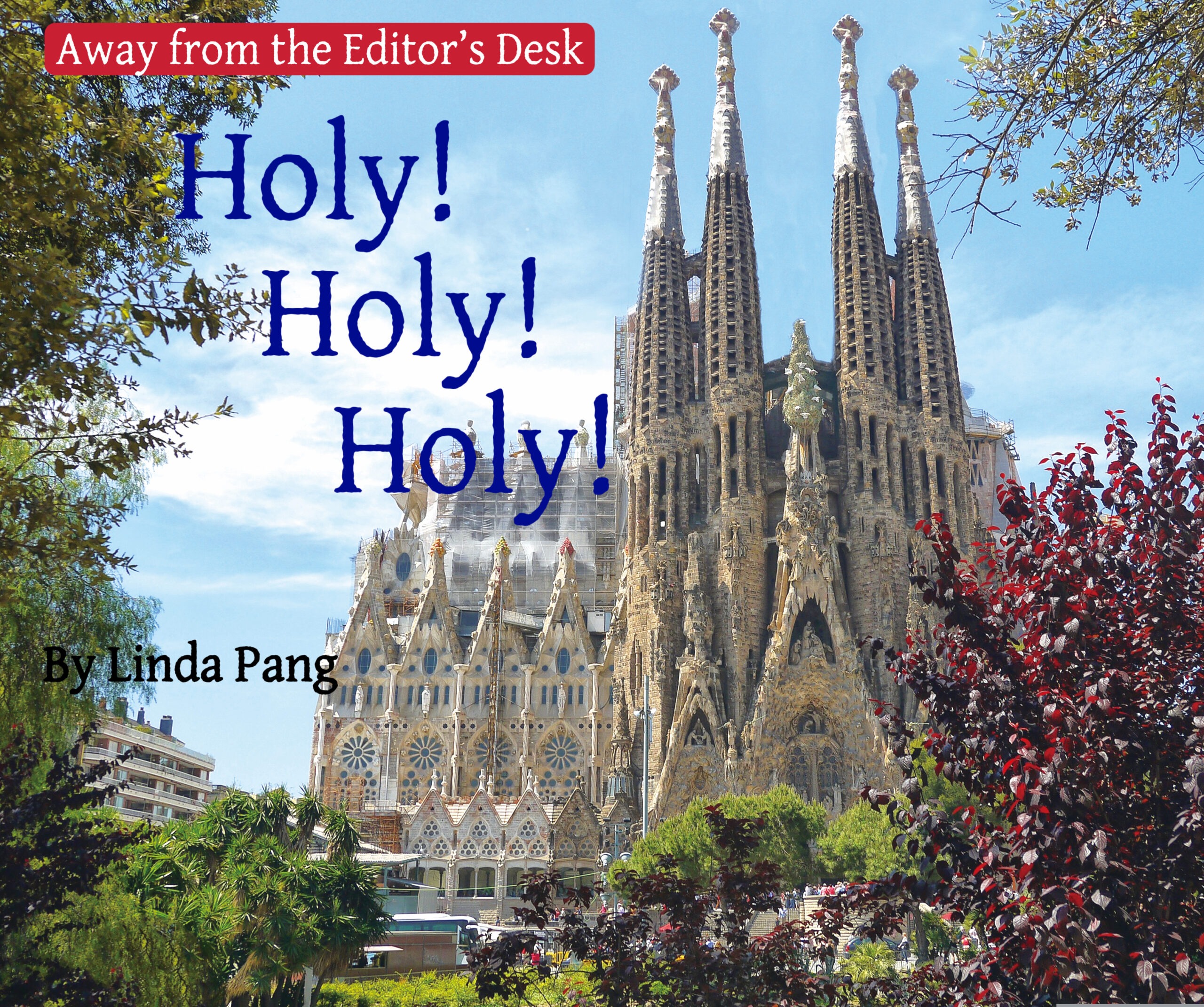
[Occasionally Away From the Editing Desk] Holy! Holy! Holy!
Sanctus! Sanctus! Sanctus!
These three words appeared on the church's soaring spire reaching toward the sky.
Holy! Holy! Holy!
More than a dozen spires on the front and rear façades rise and fall, echoing one another.
If architecture is frozen music, then this church is a hymn of praise in unceasing worship.
Located in Barcelona, Spain, the Sagrada Família broke ground in 1882, and in 1883 Antoni Gaudí assumed primary responsibility for its design. Over more than four decades, the architect devoted himself to translating his ideas and vision into detailed drawings. Despite changing times, several wars, and the relay efforts of many architects, construction continues to this day. In 1984, UNESCO designated the building a World Heritage Site, and in 2024 it attracted more than 4.8 million visitors.
In early autumn 2025, I became one of those visitors, stepping into this sanctuary that seems to chant hymns of praise.
Glad tidings descending from heaven
The Sagrada Família has two principal façades, front and rear. The theme of the front façade is the Nativity of Jesus. Its layered carvings unfold from top to bottom: at the summit, a tree crowns the structure as a sign of Christmas and a symbol of the Tree of Life; below it, the Holy Spirit circles and hovers in the form of a dove; then comes Gabriel proclaiming Mary as the one who has found favor; angels standing on either side play musical instruments, announcing the good news of Christ’s birth; shepherds and wise men rejoice and bow in reverent worship.
Yet what kind of world did Jesus come into? What kind of scene surrounded the seemingly peaceful Holy Family? King Herod ordered the massacre of infant boys, and Joseph and Mary fled to Egypt with the child Jesus. “The light shines in the darkness, and the darkness did not receive it… He came to his own, and his own did not receive him.” It is precisely in such violent darkness that the light is most needed—“to shine on those sitting in darkness and in the shadow of death, to guide our feet into the path of peace.”
Through intricate carving, hard and cold stone conveys passage after passage of Scripture, vividly bringing the Gospel narratives to life. And are not the Gospels the words God speaks to humanity? God’s word is not merely a series of stories, but the true light—full of grace and truth—dwelling among us.

▲ Image source:https://commons.wikimedia.org/wiki/File:SagradaFamiliaSanctus.jpg)

An Upward Gaze from the Ground
Circling to the other side, the rear façade depicts the Passion of Jesus. Its layered carvings rise from bottom to top: at the Last Supper, the Lord washes the disciples’ feet, breaks bread, and lifts the cup, establishing the new covenant; the betraying kiss in the Garden of Gethsemane; at Peter’s feet, a crowing rooster beside his face filled with remorse; the faces of Roman soldiers concealed by armor, yet unable to hide their brutality. Then come the arrogant Pilate and the Lord Jesus bearing the cross. Every face and limb is rendered in hard, angular lines, forming a stark contrast with the rounded, gentle forms of the front façade. Scenes of suffering, pain, and violence draw the eye to the crucified Christ—the Lord of life, who lays down his life for humanity; the Lamb who was slain to take away the sin of the world. Above him hangs a torn veil.
Yet this is not the end of the story. Beneath the pure white cross are tears of grief and gazes of reverent awe, alongside the gentle yet courageous acts of taking down the body and laying it in the tomb. The angles formed by eighteen columns resemble hands joined in prayer, and at their crowns the letters spell out a title and a proclamation—Jesus of Nazareth, King of the Jews.

▲ Image source:https://commons.wikimedia.org/wiki/File:Sagrada_Familia,_Nativity_facade_%2810%29_%2831133473332%29.jpg

The story does not end here. Look higher still: the cross is empty, and the tomb is empty as well, for He has risen. After appearing to many, Jesus Christ—who came into the world as one of us—ascended in glory, continues to intercede for humanity, and invites all who trust in Him to wait in hope for His return.
The front and rear façades of the basilica proclaim the story of Jesus Christ from his birth to his ascension, revealing the one and only way by which God and humanity are reconciled. Rising from more than a dozen spires, the words “Holy, Holy, Holy” resound as an eternal hymn of praise echoing between heaven and earth.
A Cry Bridging Heaven and Earth
The themes of birth and suffering continue within the basilica itself. The stained glass of the front façade, rendered in blues, yellows, and greens, portrays the days of Jesus’ earthly life. Bathed in light, it shines like precious jewels, full of vibrant vitality—evoking the abundant life promised by the Good Shepherd. On the opposing rear façade, the stained glass is layered in deep and varying shades of red, repeatedly reminding us that the price of human life was the blood of the Lord of life himself.
Entering through the “Nativity” façade and exiting through the “Passion” façade, does the journey through this house of worship not signify a passage from death to life?
Gaudí once said, “Light is the best painter.” For this reason, the glass at the highest point is transparent, allowing light to enter the sanctuary and illuminate everything within. As the seasons change, light from different angles creates varying degrees of brightness inside, like the “true light” accompanying humanity through the passing seasons.

▲ Image source:https://upload.wikimedia.org/wikipedia/commons/b/ba/Sagrada_Familia_nave_roof_detail.jpg

Inside the basilica, tree-trunk–like stone columns rise to a height of 150 feet, branching upward in paired parabolic lines toward the ceiling. This “stone forest” lifts worship heavenward and evokes the majestic presence of the Lord coming to all nations.
Even as one marvels at the grandeur of the architecture and the refinement of its design, the eye is inevitably drawn to the cross suspended above the altar and to Christ upon it. The suffering Son of Man lifts his gaze heavenward, as if crying out to the Father, “My God, my God, why have you forsaken me?”—and at the same time interceding for humanity: “Father, forgive them.”
Inside the basilica, streams of visitors pass by—guided explanations, the click of cameras, and murmurs of wonder lingering in the air. Sitting on a simple wooden bench, I fixed my gaze on Jesus on the cross for a long, long while, until the sounds and movements around me gradually faded away, and in a hushed moment I seemed to hear a faint cry: “It is finished.”
That cry tore the veil that separated God and humanity, bridged heaven and earth, and opened the way for us to come boldly before the throne of grace.
All Creation Redeemed, Heaven and Earth Sing Together
The Sagrada Família’s core design vision was drawn line by line by Gaudí himself. He was not only an architect, but also an artist, engineer, and scientist. Every detail inside and outside the basilica grew out of his observations and imaginative insight.
The most iconic architectural feature of the church is its layered spires rising one upon another. In an era without computer modeling—or even electronic tools to calculate complex physical forces—how did Gaudí give concrete form to the ideas in his mind?
Skilled in building physical models, he linked chains of varying lengths to metal rings, attaching sandbags of different weights where they hung down—like the pendants of a crystal chandelier. A mirror placed beneath reflected the inverted form, revealing the contours of the spires.Note
The imagery used throughout the church, inside and out, comes from close observation of living creatures: vines along the window ledges, turtles at the base of the stone walls, seasonal crops crowning the spires, and shell-like spirals hidden within the knots of the stone columns. Natural phenomena also became a source of inspiration—the perforated spheres imitate cellular growth, while the seemingly irregular pieces of tile, glass, and marble set into the tops of the towers in mosaic patterns are inspired by the structures of different crystals.

for example, the stone forest of the main hall and the seasonal harvests crowning the spires seem to express the celebration of all creation redeemed, with heaven and earth singing together.
▲ Image source:https://commons.wikimedia.org/wiki/File:Sagrada_familia_detalle_exterior_00003.jpg

The master architect once said that he learned from the great tree outside his studio, and he also remarked: “Creation, through the medium of humanity, is still ongoing. But human beings do not create… they only discover. Those who seek support for new works in the laws of nature are, in fact, co-workers with the Creator.”
By weaving images of the created world into a house of worship, was Gaudí seeking to express the celebration of “heaven and earth singing together,” as well as his confidence and hope in the redemption of all things in the new heaven and the new earth?
The Church Becomes the Gospel
Since the Sagrada Família first broke ground, the architectural styles of churches as places of worship around the world have changed significantly. They no longer resemble the neo-Gothic churches of the past, which used soaring spires, intricate carvings, and gilded ornamentation to convey the solemnity of worship. Within the Protestant tradition, the use of images, sculptures, and decorative elements is often avoided, out of concern for falling into “idolatry.” Church design has therefore become increasingly functional, shaped by the needs of ministry and the use of space. For example, an emphasis on Christian education leads to the inclusion of partitioned classrooms for Sunday school; an emphasis on fellowship results in kitchens and fellowship halls designed to accommodate shared meals.
Standing amid the flow of visitors and gazing up at this magnificent structure, I could not help but ask myself: the Sagrada Família was not conceived as a tourist attraction, but as a sacred place of worship. From the perspective of a twenty-first-century, Protestant, Chinese Christian, is it truly necessary to invest so much money, time, and human and material resources to build a church?
Yet the overall design and architectural details of the Sagrada Família are themselves lines of Scripture. Some are rendered in words—for example, the bronze doors of the “Glory” façade are inscribed with the Lord’s Prayer, with the line “Give us this day our daily bread” presented in fifty different languages. Others are conveyed through images, such as the carvings depicting the birth of Jesus and the events of his Passion.
To gaze intently at this building itself—is it not like reading the Gospels with care?
If God’s word carries power and does not return empty, can this building that bears and proclaims that word not also speak to everyone who gazes upon it?
A place of worship need not be merely a functional space; it can also communicate theological vision.
God revealed himself to the wandering Israelites in the wilderness, and the finely crafted, beautiful tabernacle built amid sand and dust was a sign of God’s presence. The design of Notre-Dame de Paris likewise conveys theology: the rounded apse represents Christ’s head; the pulpit, Christ’s heart; and the side aisles, Christ’s outstretched arms. To enter the church is, in a sense, to enter into Christ himself.
That day of my visit, heavy clouds filled the sky, and I was grateful that the rain did not begin until after I had entered the Sagrada Família. Traditionally, the space within a church where worship is held is called the main hall; the word *sanctuary* itself carries the meaning of refuge and rest. Even amid the majestic grandeur of the Sagrada Família’s sanctuary, the focus remains on the suffering Lord. Through Jesus’ self-giving, humanity is saved and redeemed, and all creation is given the possibility of being restored to its intended glory. Only when all things are redeemed will true and lasting rest be found.
For every visitor who pauses here, might it be that in contemplation they are moved to seek this faith, and stirred to receive Him as Savior and Lord of life?
Whole-Person Worship
A. W. Tozer once said, “True worship—worship that pleases God—flows out of a person’s entire life.”
Stepping away from the editor’s desk for a moment, I came to the Sagrada Família in Barcelona, capturing impressions on my phone and engraving the stirring of my heart upon my soul.
After seeing the photos, a friend asked whether the scaffolding and protective netting erected on the exterior were for repairs or for restoration. I pondered for a long time before replying to this not-so-easy question:
It’s hard to say…
After all, this building has remained unfinished for more than a century. Any work currently underway may be maintenance, restoration, or even continued construction.
Scripture says that believers’ bodies are temples of the Holy Spirit, and the Lord Jesus calls us to abide in him, and he in us. If so, is my life not also like this unfinished sanctuary—one in which God is constantly at work, repairing, restoring, and even continuing to build?
Then might my life also become a living Gospel, telling the story of God to others? And might God dwell within it as a place of rest, leading people to encounter Him?
Sanctus! Sanctus! Sanctus!
May I at all times praise and glorify the Creator!
Holy! Holy! Holy!
May I offer to God my deepest worship with my whole being!
————————————————
Note: For how Gaudí translated his design vision through physical models, please refer to the following. https://parametric-architecture.com/gaudi-architecture-science/?srsltid=AfmBOoqQwLPDKP4O+dEdV7LJnZIG8Xkum21E7pqAv9IePRzCmiVgZeLkn.