

Explore the spiritual realm of "Nomadland"
Nomadland swept three major awards at the 2021 Oscars: Best Picture, Best Director, and Best Actress. Director Chloé Zhao is truly a source of pride for the Chinese community. With no glamorous stars, no gripping plot, and not even a warm, satisfying ending, how should one appreciate this documentary-like film?
The hope is that by understanding the classic literature echoed in the film, along with the plot and pivotal turning points for key characters, readers—even if they disagree—can still comprehend the protagonist’s final choice to remain “unanchored.” While taking in the sweeping landscapes, they are also invited to explore their own inner world from a different perspective.
From the cinematography of the film, it is clear that it embraces the ideal of beauty found in simplicity and nature. This reflects the legacy of the 19th-century American movement to return to nature and establish national parks. One of the representative works of this movement is Thoreau’s Walden, in which he expresses his conviction that only by returning to the natural world can one truly experience the meaning of life. He chose to distance himself from civilization, building a small cabin by the lake and living for over two years in the most unrefined way. Thoreau believed that true wealth lies in the wisdom to break free from material dependence. He emphasized that nature needs no artificial embellishment, faith needs no packaging, and people need no masks.1 Every day, he immersed himself in careful observation, engaging deeply with all the plants, animals, natural landscapes, and seasonal changes in his surroundings. He described their mysteries and found joy in a life free of attachments. Nearly every scene in Nomadland can be traced back to the mindset found in Walden.
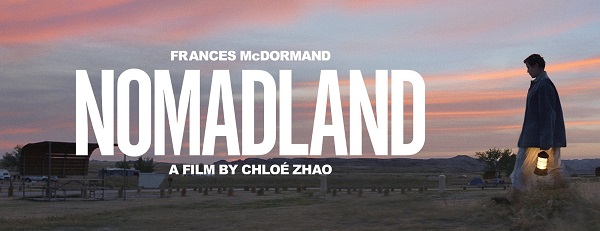
A Sojourner on the Journey
This is a classic road movie, characterized by a protagonist who sets out on an unfamiliar journey—sometimes due to persecution, rebellion, or escape, and at times partially by choice. Along the way, the journey is fraught with crises, but also gradually filled with new learning, insight, experience, and breakthrough. Unlike action or romance films, there are no heroic or seductive leads who conquer enemies or win lovers by the end. Road movies emphasize authentic storytelling, with open-ended conclusions and ongoing exploration that extends beyond the final scene. The book on which Nomadland is based references Thelma & Louise as a quintessential example of this genre. In that film, the two female leads, oppressed by men their whole lives, go on the run after killing a would-be rapist. Ultimately, surrounded by male police officers with no way out, they drive off a cliff into the Grand Canyon—embracing freedom as the ultimate form of “living happily ever after.”
The film is set against the backdrop of the 2008 financial crisis, which caused many major American companies to collapse and led to economic decline in both cities and rural areas. The protagonist, Fern, also lost her husband during that time. She was forced to leave her hometown in Nevada, where she had lived for decades, and lost the only close family she had. Everything she had relied on completely fell apart. In the most economical way possible, she converted an old, rundown van and began her life of being “houseless, not homeless.”
As traditional industries declined, Amazon emerged as a major employer, absorbing large numbers of unemployed individuals. Fern was drawn to it and joined the company, driving to a designated RV community arranged by Amazon. Each morning, she entered through an impressively branded gateway into a vast warehouse filled with state-of-the-art computerized production equipment. Everyone was busy scanning and packing; each day began with motivational talks, like a kind of morning devotion. With decent pay, benefits, and free access to RV housing, what more could an unemployed person ask for? Yet Fern couldn’t endure the inhuman, mechanical nature of the job. She chose to resign, once again facing an uncertain and difficult future.
Fern met the warm-hearted elderly woman Linda May (a non-professional actor) at Amazon, who suggested she join the RV nomad community and meet its leader, Bob Wells. There, Fern encountered a group of people in situations just like hers. They drove various patched-up, discarded vehicles, many even more dilapidated than hers. Surprisingly, this group was not self-destructive or despairing. They sang Willie Nelson’s “On the Road Again” as if it were a hymn, shared potluck meals, and often held campfire gatherings.
Like Alcoholics Anonymous (AA), they do not hide their faults but openly share the bittersweet stories of their lives. Each person learns various skills by doing them themselves and shares survival tips. They take pride in having both a roof over their heads and wheels to roam the land. Often, someone will pass around a collection of vintage treasures, each with unforgettable history; these are given freely, with the hope that the recipient will cherish and use them well. When someone faces serious difficulties, the group pools money to help in emergencies, looking out for one another. This community led Fern into a whole new realm of life.
Fern learned many valuable survival skills for living as a nomad from another elderly woman, Swankie — such as not relying on others or material things, doing her own vehicle repairs, and returning to simplicity and nature. Swankie was in the late stages of a serious illness but faced it without fear or negativity. She still planned to drive all the way to distant Alaska to fulfill her wish. Swankie strengthened Fern’s conviction about the mysterious, unconventional nature of this way of life.
Stopping or Moving On
At the same time, Dave appeared in Fern’s life. He was gentle and helpful, loved nature, worked as a ranger at a national protected park, and also diligently worked part-time at a restaurant. He was willing to share his past with Fern. Aside from accidentally breaking the plate Fern’s father had given her in college while helping her, almost every step seemed like a green light for building a relationship. He seemed like a very suitable partner for marriage. One day, Fern’s son appeared and took the initiative to reconcile with Dave, inviting him to live together. Dave invited Fern to join them, but Fern declined this sudden proposal and continued her wandering, even trying a tougher job in a stone quarry.
This film, which resembles an American Western, reveals upon closer observation how the director incorporates Eastern virtues of modesty, restraint, and self-discipline into the characters. In the Chinese classic Journey to the West, Tang Sanzang (Tripitaka) lacks supernatural powers or extraordinary martial skills and often stubbornly adheres to seemingly insignificant principles, yet manages to overcome countless hardships. “Being uncontentious with the world” seems to be Tripitaka’s sole mastery, a theme that runs through Journey to the West and also through the main character in Nomadland. During her Oscar acceptance speech, director Chloé Zhao mentioned that as a child she recited “At the beginning, people are inherently good” with her father, and this core belief of “nomads are inherently good” is evident throughout the film.
The car breaking down made Fern realize that the nomadic life was not entirely free and easy, and she thought about going to find Dave. It was a small farm, far from the noise of the city, where many chickens were raised. Dave’s family lived harmoniously across three generations, and the whole family liked Fern very much. The simple and comfortable home was not luxurious at all; Dave’s personality seemed to be a perfect match. Where else could one find such conditions?
If the story ended here, wouldn’t that be quite good? Fern, touching the comfortable furniture, contemplates settling down — no longer lonely, no longer drifting from job to job. It seems as if heaven is making up for everything she once lost. As she looks back on those years without a home, continually meeting kind new friends and overcoming new challenges while being immersed in the raw beauty of nature, she is no longer the lonely, helpless young woman she was at the beginning of the story.
Life’s hardships have already made her mature and strong; even if the sky falls, she can withstand it. At this moment, Fern’s face reveals the award-winning layers of struggle and determination. What kind of decision will she make?
The journey is still ongoing.
The Old Testament is filled with stories of wandering and being without a home. Joseph fell from the paradise of being favored by his father Jacob to the depths of slavery in Egypt, and was later falsely accused and imprisoned. Naomi lost her husband and sons in Moab and depended on her daughter-in-law Ruth. Esther and the Jews faced the threat of annihilation in Persia. Daniel was taken captive to Babylon and faced life-threatening crises multiple times.
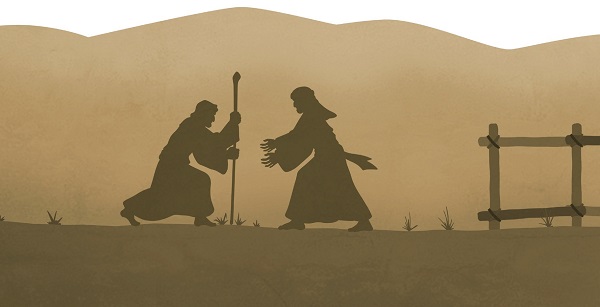
People’s wandering and homelessness sometimes arise from rebellion, and sometimes from adversity. If these wandering and homeless people can avoid complaints, and instead hold on to their faith in the Almighty God with perseverance, effort, and integrity—maintaining strong faith even in difficult circumstances—wouldn’t that be because they know that the God they believe in is trustworthy and is the Lord who leads them home?
Reflecting on what Jesus said in the Sermon on the Mount—blessed are the poor in spirit, those who mourn, the meek, those who hunger and thirst for righteousness, the merciful, the pure in heart, the peacemakers, and those who are persecuted for righteousness’ sake. Though these lives or states of being may seem to the world as unstable or vulnerable, what is it that makes them truly blessed? Jesus also said, "Come to me, all who labor and are heavy laden, and I will give you rest." (Matthew 11:28) In this film, which does not emphasize religious faith, can we find inspiration to return to the Lord’s teachings and promises?
In the field of life story studies 2 , simple stories end with external gains; good stories focus more on internal rewards; high-quality stories center on growth toward maturity. Fern has grown and matured. Nomadland reminds us not to envy others’ wealth, to let go of resentment toward the world’s injustices, not to seek special treatment, but to take responsibility for ourselves and watch over our neighbors.
What motivates us to continue on life’s journey? What reasons lead us to choose to travel alone or to go together with others? And what kind of perspective can prompt us to reflect—is this journey a wandering, or a coming home?
I believe that when we open our eyes and experience the beauty of creation, we can still bravely overcome challenges and grow through trials, firmly believing that the truth, goodness, and beauty of life are still waiting along the road ahead!
Note:
1. Thoreau said:“I went to the woods because I wished to live deliberately, to front only the essential facts of life, and see if I could not learn what it had to teach, and not, when I came to die, discover that I had not lived.” He also said, “A man is rich in proportion to the number of things which he can afford to let alone.”(Henry David Thoreau, Walden, Simon & Shuster, 1854)
2. Foley Center for the Study of Lives, Northwestern University, Evanston, IL.
Professor Zou Jian, was born in Taiwan and immigrated to the United States at the age of 13. He holds a Ph.D. from Fuller Seminary. Influenced by both parents being teachers, He also love teaching. He has taught in communities, churches, kindergartens, and seminaries, and has also served as dean of seminaries. He believes that God’s call is to devote himself to caring for the disadvantaged and to bridge the gap by studying people’s life stories.