
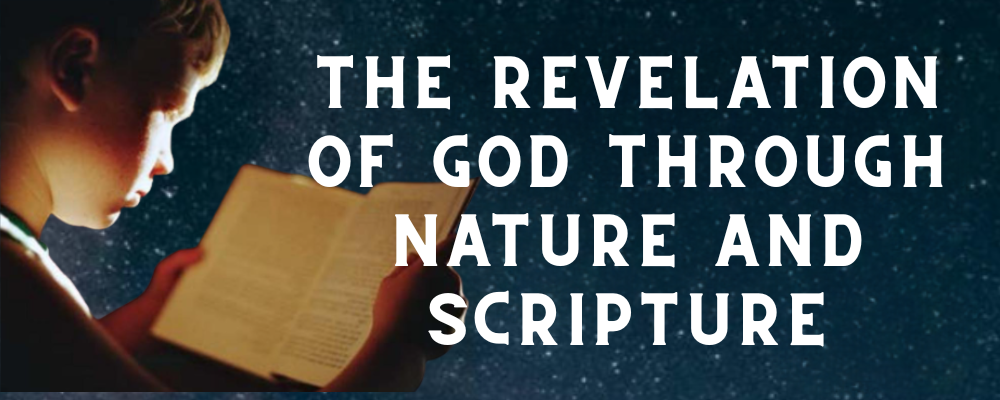
The Revelation of God Through Nature and Scripture
The heavens declare the glory of God; the firmament proclaims His handiwork.
Day after day they pour forth speech; night after night they reveal knowledge.
The law of the Lord is perfect, refreshing the soul.
The statutes of the Lord are trustworthy, making wise the simple.
But who can discern their own errors? Forgive my hidden faults.
Keep your servant also from willful sins; may they not rule over me. Then I will be blameless, innocent of great transgression. May these words of my mouth and this meditation of my heart be pleasing in your sight, Lord, my Rock and my Redeemer.
May these words of my mouth and this meditation of my heart be pleasing in your sight.
(Psalm 19:1-2, 7, 12-14)
Seeing the Invisible God through the Visible Creation
How does God make Himself—the invisible One—known to us? Psalm 19 presents two major themes: the “book of nature,” and the “book of Scripture.” They are His index, His evidence, and His invitation for us to receive the power of faith.
Like in Psalm 8, the psalmist David, in the first half of this psalm, presents the heavens, the skies, day and night, and the sun as actors taking turns on the grand stage of the “Book of Nature,” set against the backdrop of the universe. In the second half, through six instances of Hebrew parallelism, the focus shifts from the Book of Nature to the Book of Scripture—a revelation powerful enough to transform the human heart. David concludes with a personal prayer, stirred by the Lord’s law, asking God—his Rock and Redeemer—to shine light into the hidden corners of his heart. His hope is to be cleansed and become one who pleases God, thereby inviting the reader into a journey of faith and dialogue with the divine.
The first step of faith often begins with “seeing.” This process parallels the message of Romans, which expounds justification by faith—where Paul urges readers to lift their eyes and “see” what God has made, in order to understand His eternal power and divine nature. Likewise, the Magi from the East began their journey because they “saw” the star of the One born King of the Jews. Step by step, they followed it to Jerusalem, and eventually to Bethlehem (see Matthew 2:1–11), where they found the “Star of Jacob” foretold in the Torah (see Numbers 24:17)—Jesus—and worshiped Him with gifts.
When we gaze at the sky, we may see only the rising and setting of the sun and the twinkling of stars—that is called "sight." But when the psalmist David looked up, he opened this majestic hymn with parallel phrases: “The heavens declare the glory of God; the skies proclaim the work of His hands.” David saw more than what met the eye; he saw the transcendent God behind all of creation. Management expert Peter Drucker put it well: “The marksman is not great because of his bow, but because of his aim.” The psalmist had that kind of precise insight—which enabled him to perceive the Creator behind the created world.
Sight is not the same as insight. A blind person may lose physical sight, yet often possesses the kind of insight that many with clear vision lack. Sight sees only the natural world; insight perceives the God behind it. It was this kind of insight—beyond mere eyesight—that moved David to praise the God above the starry skies. Paul echoed this truth, writing that “since the creation of the world, God’s invisible qualities—His eternal power and divine nature—have been clearly seen,” leaving people “without excuse” (Romans 1:20). While human sight may observe the heavens and the skies, the psalmist’s insight sees beyond—to recognize that all creation exists to declare the glory of God and to proclaim the work of His hands.
From the perspective of the history of scientific development, many scientists who fueled the Industrial Revolution—including Isaac Newton—pursued science in order to glorify God. For nations to truly advance in science, they need theological insight as a foundational support. Joseph Needham, author of Science and Civilisation in China, pointed out that one reason science struggled to develop in China was the absence of theology. During the May Fourth Movement, intellectuals such as Kang Youwei and Liang Qichao had sight—they saw the West’s military might and technological advancement, and also China’s feudal corruption. They believed that importing “Mr. Science” and “Mr. Democracy” would revitalize the nation. Yet what they failed to see was that the development of science and democracy in the West was built upon a solid theological foundation. Sadly, even today, some intellectuals remain trapped in the illusion that merely importing the Statue of Liberty will automatically bring democracy.
It was with God-centered insight that Einstein could sincerely say, “I want to know God’s thoughts; the rest are details.” Newton, too, had such insight—his desire was to explore the laws of the invisible God through the observable, unchanging patterns of nature. His true motivation for studying science was theological. In fact, over 90% of his writings were theological in nature; only the remainder—on mechanics, optics, and even calculus—were scientific.
Nature remains constant because there is an unchanging God; it is precisely because God does not change that scientific laws can exist. This reveals a deeper truth: any attempt to build a nation’s culture—including its science, democracy, politics, legal systems, and arts—must begin with a foundation in theology. Psalm 19 opens by emphasizing that the heavens and skies, and all of creation, exist to declare the glory of God. This was also the conviction of the Reformer John Calvin, who taught that “man must submit to the sovereignty of God, and all things exist for the glory of God.”
Freedom on the track
Returning to David’s narrative in Psalm 19, the first actors to appear are the heavens, the skies, day, and night. Though “their voice goes out into all the earth, their words to the ends of the world,” they are merely the prelude to what God has set in motion: a tent for the sun. David reserves the climax of his description of the “book of nature” for the sun, portraying it as “a bridegroom coming out of his chamber, like a champion rejoicing to run his course.”
The sun draws its heat and fulfillment from running along the path God has marked out for it—“rising at one end of the heavens and making its circuit to the other.” Its influence is so vast that “nothing is deprived of its warmth.”

True joy for created beings comes from living within the limits set by God. As Immanuel Kant once said, “Freedom without constraint is not true freedom.” Similarly, Swiss theologian Emil Brunner noted that human freedom is grounded in dependence on God—that the greatest freedom is, at the same time, the greatest dependence. This is exactly what Jesus taught: “If you hold to my teaching, you are really my disciples. Then you will know the truth, and the truth will set you free.” (John 8:31b–32)
The great Russian writer Ivan Turgenev once received a letter from a friend, in which the friend wrote an insightful line: “The greatest thing in life is to place yourself second.” In his reply, Turgenev offered an even deeper reflection: the real question in life is deciding what to place ahead of yourself—what to put first. That, he said, is the central issue of one’s entire life.
Charles Spurgeon once shared a preacher’s secret to effortless ministry: “Preaching is like a train—it runs most smoothly when it stays on the tracks. Unless God continues to lay the rails, no amount of human effort can move it forward.” Likewise, when God’s children are willing to be like the sun—confined to the stage God has appointed, yet burning and running with all their might—they will find true freedom and radiate God’s joy and glory. The great figures of Scripture—Moses, Isaiah, Jeremiah, Paul, Peter, and John—are all living proofs of this divine principle.
Nature lights the way; Scripture lights the soul.
Yet the sun cannot expose hidden faults, and science cannot convict the heart of sin. After describing the “Book of Nature,” the psalmist goes on to portray the “Book of Scripture” as more precious than jewels and sweeter than honey, emphasizing that it is the true source of wisdom and instruction for humanity: “The precepts of the Lord are right, giving joy to the heart. The commands of the Lord are radiant, giving light to the eyes” (Psalm 19:8–9).
The “Book of Nature” may illuminate the human path, but only the “Book of Scripture” can enlighten the human heart. The Book of Nature reveals general revelation, while Scripture carries special revelation. The most precious thing God has made is not nature itself, but His Word. Heaven and earth will pass away, but His Word endures forever. Man does not live by bread alone, but by every word that proceeds from the mouth of God.

In terms of educational impact, the Bible stands alone in its power to revive the soul, bring joy to the heart, enlighten the eyes, and impart wisdom to the simple—an influence unmatched by any other book in human history. It is no wonder that many top figures across various fields are Jewish, a people who revere the Old Testament as their guiding light. For this very reason, John Bunyan—who came from poverty and lacked formal education—was able to write The Pilgrim’s Progress, the most famous allegory in Christian literature. In the 20th century, two of the most influential literary figures, J.R.R. Tolkien and C.S. Lewis, were deeply shaped by The Pilgrim’s Progress. Tolkien’s The Lord of the Rings can even be seen as a modern retelling of Bunyan’s work, and Lewis, a converted Oxford professor, boldly declared that the Christian faith is, in itself, a form of education.
Martin Luther believed that the prosperity of a nation does not lie in a full treasury, strong fortresses, or well-developed infrastructure, but in the character of its people—specifically, the education they receive, the clarity of their vision, and the excellence of their moral character. G.K. Chesterton similarly remarked, “Education is the soul of a society as it passes from one generation to another.” And John Calvin went even further, warning that “without the law of God, man becomes a beast in the wilderness.”
Reading the Scriptures transforms lives
Reading the “Book of Nature” does not change the human heart, nor does it reveal one’s hidden faults. As John Newton, author of the hymn Amazing Grace, once said: “A man can know he is a sinner not by being told, but by being enlightened by a holy God.” Those who read only the Book of Nature will not call themselves “servants,” will not pray, “Keep your servant also from willful sins,” nor will they be moved to ask, “Forgive my hidden faults.” Instead, they often continue down their own way, unaffected and unchanged, lacking the inner reflection that comes only through the light of God’s holiness.
Reading the “Book of Nature” relies on physical sight—vision that observes the world outside the reader’s eyes. Only when illuminated by the “Book of Scripture” and moved by the Holy Spirit does the reader gain the motivation for reflection, self-examination, and repentance. It is then that one becomes open to correction and willingly embraces God’s commandments as part of personal, private life. The desire grows to follow God's ways, just as all creation does—not only to do what pleases Him and become one whom He delights in, but also to be one whom He lovingly sets apart under His guidance and boundaries.
Reading the “Book of Nature” changes the way we see the world; reading the “Book of Scripture” changes the way we see ourselves. Reading nature is safe—it doesn’t threaten our way of life. But reading Scripture is dangerous, because it changes us. It leads to surrender, and we willingly let God take hold of our lives and become His servants. No wonder a British Prime Minister, after attending a church service, was overheard muttering as he walked out, “If religion ever begins to interfere with private life, the consequences are truly unthinkable.”
Immanuel Kant once said that two things filled him with awe: the starry sky above and the moral law within. Yet what truly satisfies the human heart is the One who created it. In the final prayer of this psalm, the psalmist reveals that what convicts, humbles, and leads to repentance is not science or human morality, but the Redeemer foretold by both the Book of Nature and the Book of Scripture—the Jesus of the New Testament, the risen Messiah. The ultimate purpose of both Nature and Scripture is to lead us to a personal Redeemer.
With the risen Lord, God’s children can experience His protection even in times of hardship—for our Redeemer is omnipresent and omnipotent. In Salomé, Oscar Wilde portrays King Herod’s reaction upon hearing that Jesus of Nazareth had risen from the dead. Herod exclaims, “I do not wish Him to do that. I forbid Him to do that. I will not allow anyone to rise from the dead.” Then, in anxiety, he demands, “Where is this man?” A courtier replies, “He is everywhere, my lord… but He is hard to find.”
The Reflective Power of Faith
Genuine faith involves not only sight and insight—but also reflection. After reading both the “Book of Nature,” which declares general revelation, and the “Book of Scripture,” which carries special revelation, the psalmist is finally illuminated by the light of the Redeemer foretold in Scripture—Jesus. He reflects, examines, and responds, humbly acknowledging himself as a servant, aware of his hidden faults and willful sins. He pleads for forgiveness and prays to be set free from the dominion of sin.
This reveals that only those who have been forgiven by the righteous God revealed in Scripture can truly grasp the greatness of His love and the depth of their own imperfection—and then go on to live out the goodness God has ordained for them. As John Piper rightly said, “Redemption doesn’t make us perfect; it helps us see our imperfection.” And because of Jesus’ redemptive work, “The only difference between a saint and a sinner is that every saint has a past, and every sinner has a future” (Oscar Wilde).
Reading the “Book of Scripture” transforms our lives, allowing us—like nature itself—to become God’s handiwork, masterpieces in the hands of Jesus. As Vincent van Gogh once said, “Christ is more of an artist than the artists; He works in the living spirit and the living flesh. He makes men.” God’s grace still abides, through many sunsets glowing with mercy. In one of the final months before his death, van Gogh painted The Raising of Lazarus—and he gave Lazarus his own face.

▲ Image source:https://commons.wikimedia.org/wiki/File:Vincent_van_Gogh-The_raising_of_Lazarus_%28after_Rembrandt%29-Google_Art_Project.jpg.
The conclusion of Psalm 19 lifts the reader’s eyes toward the future: by trusting in the “word” of Scripture, which points to Jesus—the “Rock” and “Redeemer” (the Word made flesh)—we can experience strength and joy through deliverance from our weakness.
Geoffrey Bull, a British missionary to Tibet, was imprisoned in a death cell in Chongqing for three years and subjected to brainwashing and torture. During his captivity, his Bible was confiscated. In a moment of deep despair, a radio outside his prison cell suddenly began playing Beethoven’s Piano Concerto No. 5, famously known as the Emperor Concerto. The majestic, triumphant music stirred his soul—did not the power and glory of the Lord of heaven and earth far surpass that of any earthly ruler? In that instant, he was renewed in spirit. Strengthened by the Rock and Redeemer who reigns over heaven and earth, he emerged from the shadows of his missionary suffering and later authored the book When Iron Gates Yield.
God’s grace is prepared for every person in the world who believes in Him, and this promise is fulfilled in Jesus. Lin Yutang—a scholar who devoted his life to studying literature and history across cultures and who came to faith late in life—once said that no one has ever spoken words as comforting as those of Jesus: “Come to me, all you who are weary and burdened, and I will give you rest. Take my yoke upon you and learn from me, for I am gentle and humble in heart, and you will find rest for your souls.” (Matthew 11:28–29)
Jesus once calmed the storm for His disciples—so don’t complain about how big your storm is; tell the storm how great your God is! You can cast your burdens on the Lord and need not fear tomorrow, because He is already there, waiting. Yes, you don’t need to know what the future holds—just know that He holds the future.
The power of faith comes from the Lord who created and governs the “Book of Nature” and who became flesh as the “Book of Scripture.” Through both the Book of Nature and the Book of Scripture, the invisible God is made known and revealed.
Rev. Timothy San-Jarn Wu, professor of Old Testament at China Evangelical Theological Seminary, director of the Doctoral Department of Pastoral Studies and Doctoral Department of Mission.
Whatever your hands do...
手是另一張臉 不知道你有沒有仔細凝視過自己的手?手是另一張臉,傳遞著許多代表個人的信息。 …The Danger of Abstraction
你們會憑著他們的果子認出他們。葡萄不是從荊棘上採集來的,無花果也不是從蒺藜上採集來的,不是…A Lesson from Two Emperors
從西元 303 年到 311 年,東羅馬帝國的奧古斯都皇帝戴克里先(Diocletian)…















_-_Google_Art_Project.jpg)