
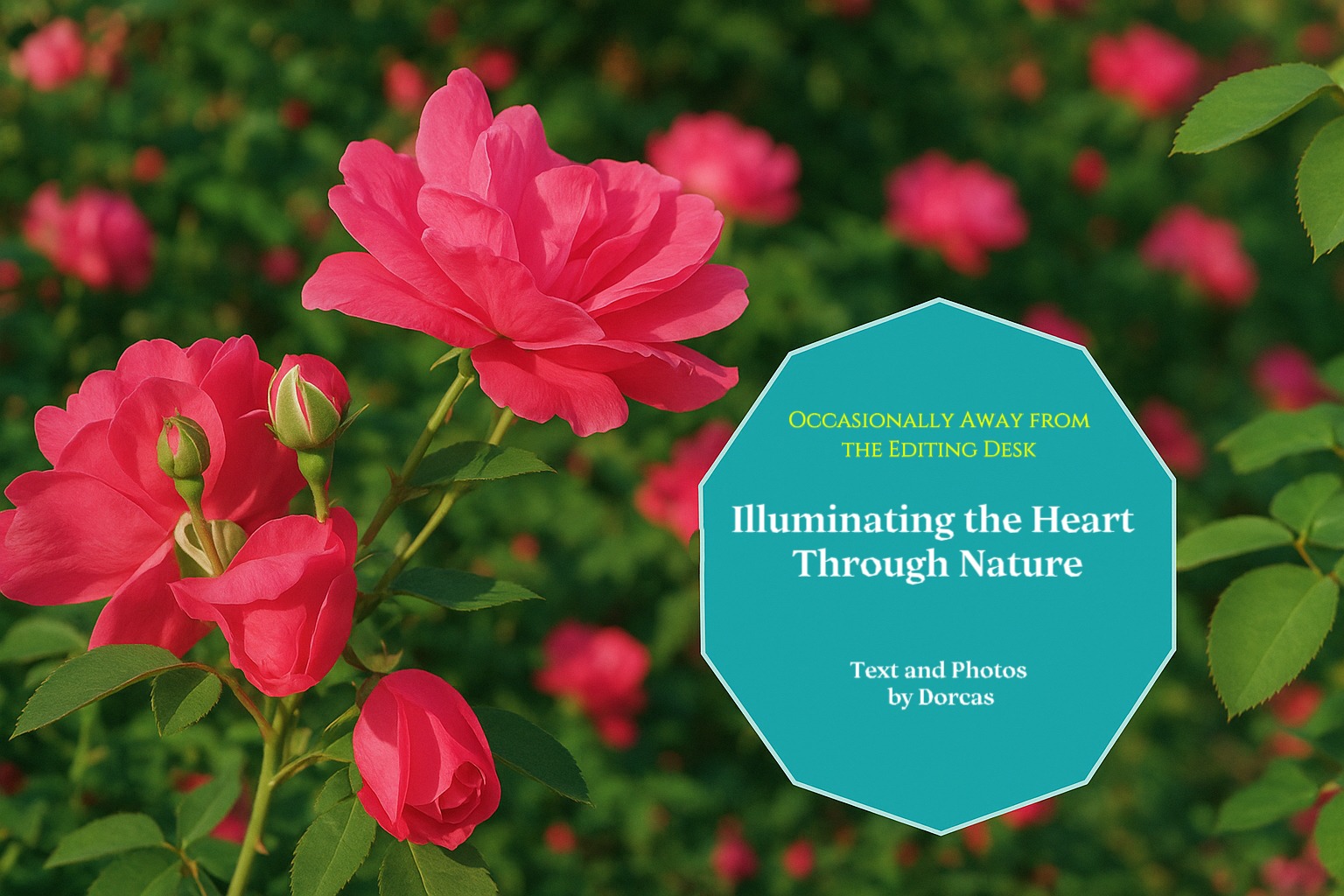
Illuminating the Heart Through Nature -- Occasionally Away from the Editing Desk
Text and Photos by Dorcas
Staring at a computer, tablet, or smartphone filled with densely packed text all day long, my aging eyes inevitably often feel tired and bleary. Therefore, I must leave my small room every day and go out for walks of over two hours. Wandering in nature, surrounded by lush greenery, birdsong, and fragrant flowers, not only allows my eyes to fully rest but also exercises my body, while letting my spirit spread its wings and soar freely. Most importantly, it enables me to look up in worship to the Heavenly Father who created the universe and all things, enjoying the feast carefully prepared by the Father that greatly benefits body, mind, and spirit.
Thinking Reed
I took a leisurely walk to the botanical garden near my home, and as soon as I entered, I saw several gracefully swaying reeds. Their fragility particularly caught the attention of the famous French mathematician, physicist, philosopher, and theological thinker Blaise Pascal, who mentioned them in his Pensées: "Man is but a reed, the weakest in nature, but he is a thinking reed. A vapor, a drop of water, is sufficient to kill him. But even if the universe were to crush him, man would still be nobler than his slayer, because he knows that he is dying, and the advantage the universe has over him. The universe knows nothing of this. All our dignity consists, then, in thought. By it we must elevate ourselves, and not by space and time which we cannot fill. Let us endeavor, then, to think well; this is the principle of morality."

Indeed, God created us as living beings with souls precisely so that through various things, we would contemplate our relationship with the Creator, with nature, with others, and with ourselves.
I improvised my own verse—though lacking in proper tune, it overflowed with heartfelt sentiment:
An old woman casually expresses her enlightenment through nature: Spring's fragrant blossoms, summer's lush green light, autumn's moon bright and pure, winter's cold enduring wind and frost;
All things wax and wane in their appointed time, each according to its kind, without haste or alarm.
All day long I leisurely wander the small garden, slowly appreciating, carefully observing—creation's wonders, everywhere I look, treasures abound;
All things ultimately follow nature's laws, conforming to Heaven's will, no need for alarm.
Looking at those reeds swaying in the wind, the dialogue between the reed and the tree from Aesop's Fables faintly echoed in my ears—One day, a fierce wind broke the tree. Seeing that the weak little reed remained completely unharmed, the tree asked, "Why is it that I, so sturdy and strong, was broken by the wind, while you, so slender and weak, suffered no harm at all?" The reed replied, "We, knowing our own weakness and frailty, bowed our heads and yielded to the wind, avoiding its forceful impact; but you, relying on your strength and sturdiness, fought against it with all your might, and as a result were broken by the gale."
How much inspiration this small reed brings to humanity!
The Life Rhythms of Plants and People
Walking into the rose garden, thousands of charming flowers competed in beauty. I observed carefully and discovered that the flowers on the same branch don't all bloom at once—some are still buds waiting to open, some are blooming extravagantly, while others have already withered and faded. Yet they all naturally and quietly bloom and wither according to their appointed time. In contrast, when humans face death, they cling to life with great reluctance. While alive, at whatever stage, people constantly compete and compare with others—when superior to others, they become complacent and arrogant; when inferior, they resent the world and wallow in self-pity. Look at the flowers!
Walking further to several large trees, I saw the leaves at the treetops trembling incessantly in the wind—truly "the tree desires stillness but the wind does not cease." This brought to mind the late USC professor Leo Buscaglia's 1982 children's picture book The Fall of Freddie the Leaf. It begins with the protagonist, a leaf named Freddie, being born and budding in spring, and together with other leaf friends on the tree (including Daniel, the oldest and wisest), experiencing the spring breeze, summer sunshine, autumn frost, and finally winter snow in the cycle of seasons. As the climate changes, the leaves gradually wither, and each leaf faces the moment of leaving the branch and falling to the ground, thereby inspiring readers on how to view death correctly.
And American writer O. Henry's famous short story "The Last Leaf" also makes a great deal out of a single leaf. A seriously ill person becomes depressed, gazing at a vine on the wall outside the window, believing that when the last leaf falls, her life will end as well. An old painter braves wind and rain to climb a ladder and paints a realistic ivy leaf on the wall. After the storm passes, the patient sees that this leaf hasn't fallen despite the fierce wind, feels encouraged, gradually regains hope for survival, and ultimately recovers. Of course, that's merely the novelist's fantasy—life will ultimately end!

Seeing the trellis nearby covered with morning glories, they seemed to be joyfully blowing their trumpets at any moment. Actually not—their lives are very brief, blooming only in the morning and withering by noon. So there's a saying that because they bloom when the morning star is still in the sky, corresponding to the star Altair (the Cowherd Star) in the heavens, they are called "morning glories" (牽牛花, literally "cowherd flowers"). The English name "morning glory" and the Japanese name "asagao" (朝顏, "morning face") are more elegant and poignantly beautiful.
Song Dynasty poet Shi Qingchen's poem "Morning Glory" vividly and poetically depicts its brief life:
A pool of heavenly dew dyes its crimson robes, fearing the red dust will fly as the sun climbs high.
In haste it arranges its verdant jade array, crossing the celestial river home in morning light's display.
The small, unremarkable morning glories, through those poignant names and verses, made me linger and hesitate to leave. They reminded me once again: there is a time for everything; each person's life also has God's specific arrangement. Regardless of length, living out the meaning of one's own life is the most important and most joyful thing.
Cultural Stories Behind Flower Names
Beyond the serious and weighty topic of death, we can also see humanity's rich imagination through the names of flowers.
In summer, pansies (butterfly flowers) can be seen everywhere, with petals that vary in size, color, and pattern. Interestingly, their names in different cultures are quite fascinating. For example, in French it's *pensée*, meaning "thought," perhaps because the shape of the petals resembles a face? In German it's called "little stepmother": among the five petals, the middle two and the bottom one look similar, seeming like a biological mother and daughters; while the top two petals look different from these three, floating above in a somewhat detached manner, like stepdaughters.

Russians, however, give it a nickname: "Ivan and Maria." According to legend, Ivan and Maria were brother and sister who had been separated for many years without knowing it. Later, they fell in love at first sight and married. When they learned of their true relationship, they were devastated, yet unwilling to endure the pain of separation again, so the two transformed into a two-colored flower. A Jewish poet living in Russia, Shaul Tchernichovsky, named this flower after Amnon and Tamar, the half-siblings among King David's children in the Bible.
Who would have thought that such a small pansy could carry so many stories!
In the past, when walking on grass, I would unconsciously search for four-leaf clovers. Later I learned that the reason it has four leaves is actually due to a genetic mutation in the three-leaf clover, occurring with a probability of about 1/5,000 to 1/10,000—extremely rare, and therefore considered a symbol of luck. However, when humans have genetic mutations and their appearance differs from the norm, they are viewed as deformed and unfortunate. This contrast makes one sigh at the contradictions and ironies in human values.
The Power of Delicate Vines
I saw a wall covered with ivy. It turns out these vines can climb walls by attaching themselves with small roots that act like suction cups. These delicate, slender roots surprisingly have such great strength, allowing the entire vine to cling tightly to the wall. This brought to mind the article in issue 66 of this magazine written by Kang Jieli, "Looking for beauty in life" which also depicted another plant's miraculous gripping power. Winter melons grew in her backyard, weighing over twenty pounds, yet they could still hang on the trellis, with vines only as thick as a finger firmly holding these enormous winter melons. These seemingly soft and delicate little vines surprisingly possess such great strength. In these small plants, God displays His mighty power—how much more so in us humans! So the Bible says: "My grace is sufficient for you, for my power is made perfect in weakness." How trustworthy this is!

When I occasionally step away from the editing desk, I thank the Lord for allowing me to experience God's wondrous creation and its laws in every leaf and every flower. I've turned these insights from nature, gathered bit by bit, into devotional videos to savor and reflect upon anytime. If you'd like to watch them, please scan the QR Code.

Dorcas, after retiring from over 30 years of computer programming work in the United States, now assists this magazine with proofreading, audio recording, website article updates, and editing.