
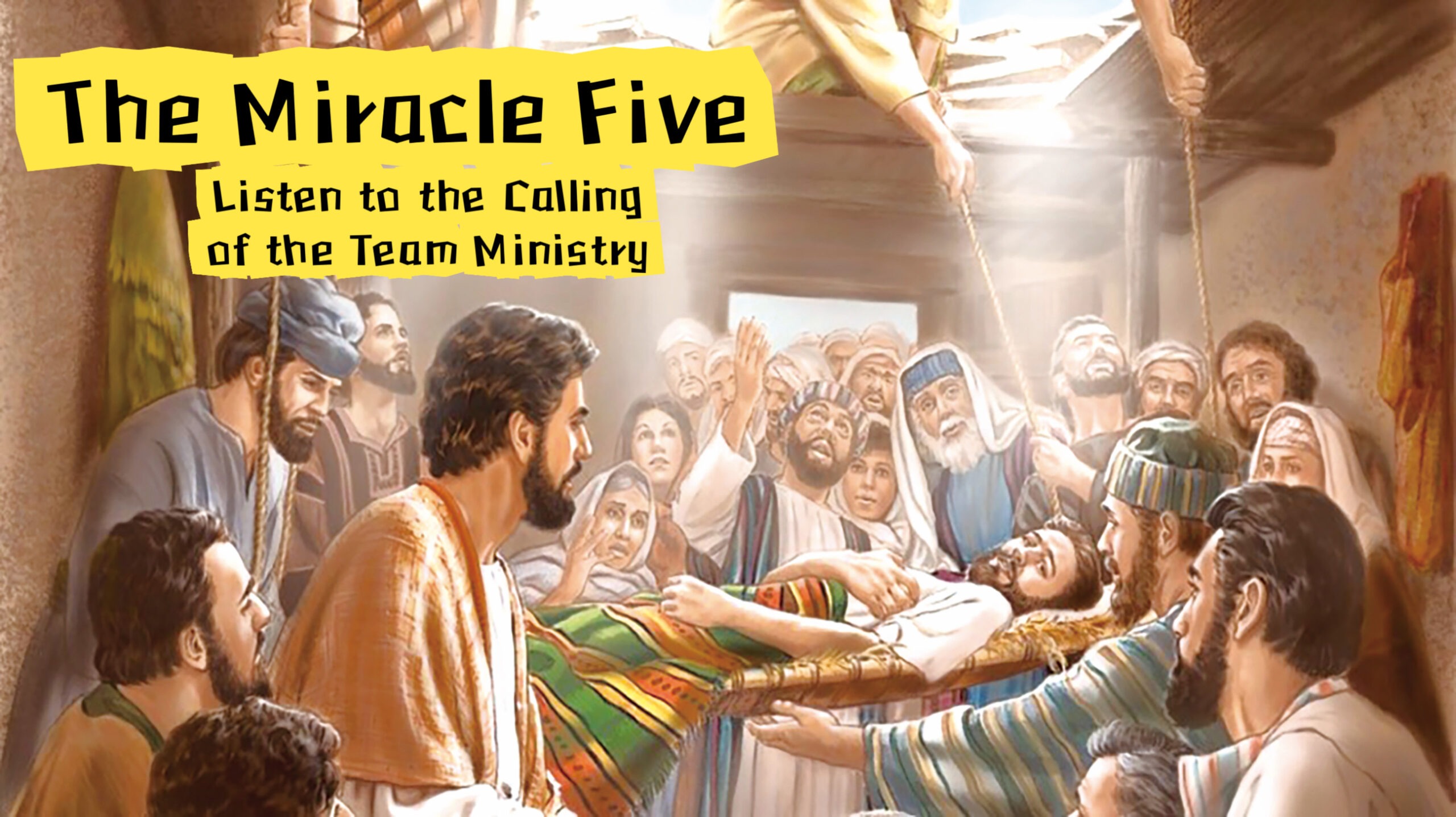
The Miracle Five -- Listen to the Calling of the Team Ministry
The Team Ministry of the "Roof-Breaking Four"
When discussing team ministry, the biblical example that immediately comes to my mind is the roof-breaking team from Mark 2:1-12. The paralytic's four friends weren't conducting a demolition project—they only made a hole large enough to lower one person down. I'll call this team "The Roof-Breaking Four."
What characteristics of a God-honoring team can we see from them?
First, faith must be "personal," but it is not "private." We must establish an individual and intimate relationship with Jesus, but true faith is absolutely not just a matter between "Jesus and me."
Let us remind one another: Mature faith should also have a positive impact on all who need Jesus within the scope of our reach. What helps us achieve this, besides individual service, is even more dependent on team ministry.
One of my writing colleagues, Shi Lingyu, once wrote:
While watching a film, I heard a thought-provoking line: "History has never been about when, why, or how things happened—history is always about 'who.'" The key to history lies not in the timing, reasons, or processes of events, but in the people themselves. It is what kind of people, what choices they made, and what beliefs they held that truly changed the course of history.
Isn't this a profound interpretation from another angle of what I repeatedly emphasize in my writing classes: "The worker comes before the work, the author matters more than the work, and authenticity surpasses everything"? This principle applies to each person's self-positioning and, of course, also applies to the collective self-identity of an entire team.
From the account in Mark chapter 2, we can clearly observe the characteristics of a mature team displayed by "The Roof-Breaking Four": In steadfast trust in the Lord, they were willing to listen to the call to show mercy; willing to listen to the call to use creativity; willing to listen to the call to work together in unity. While these cannot encompass all the characteristics of God-honoring team ministry, they do vividly present three key dimensions.
Quality 1: Willing to Heed the Call for Compassion
When seeing someone or something, hearing a voiced or voiceless cry, feeling a strong stirring within, and involuntarily responding—this is compassion. Compassion captures our attention, grips the heart, and compels us to take action to care and help.
This can be said to be a commandment with a promise, just as the Lord Jesus proclaimed in the Sermon on the Mount: "Blessed are the merciful, for they shall receive mercy!"
The Lord Jesus Himself is the best example of practicing compassion: "When he saw the crowds, he had compassion on them, because they were harassed and helpless, like sheep without a shepherd." (Matthew 9:36)
These four friends could have left the paralytic where he was, allowing him to continue living in his predicament. But driven by love, they actively took action, choosing to carry him to see Jesus. One characteristic of team ministry is that partners can together listen to the call to show mercy. How can we claim to have faith yet be cold and indifferent toward people? Showing mercy is a way of responding to God's love and is also a bridge for connecting with the broader audience.
A popular saying online goes: "'Being a busybody' makes the world a better place." "Being a busybody"—being warm-hearted and eager to get involved! But my colleague Rev. Kaofang Yeh put it even more aptly: "Christians are people who 'love' to meddle in others' affairs!" Proactively using "love" to care for and help others, seeing our own responsibility in others' needs, and also seeing the resources we can share.

Showing mercy, in a broader sense, also includes the entire team working together to fulfill the vision and mission entrusted by God. The ongoing operation of "Kingdom Resources for Christ" is precisely an example of this.
Showing mercy can be directed toward one person, a group of people, and if capable, can even cross borders and generations, becoming a global charitable action that spans centuries. Haven't countless Christians throughout history been doing just this?
Veteran writer and founder of Genesis Chinese Writing Ministry Institute, Teacher Mofei, emphasized in her lecture series "Listening to the Groans of the World": Compassion includes compassion for oneself, compassion for others, compassion for the environment and all creation, and compassion for the marginalized and vulnerable in the world. Through this, we realign our relationship with God and take action to heal, restore, and improve.
Showing mercy can further extend to seeing our own responsibility and resources in the needs of team members. Barnabas in the book of Acts is an excellent example.
"When he came to Jerusalem, he tried to join the disciples, but they were all afraid of him, not believing that he really was a disciple. But Barnabas took him and brought him to the apostles. He told them how Saul on his journey had seen the Lord and that the Lord had spoken to him, and how in Damascus he had preached fearlessly in the name of Jesus. So Saul stayed with them and moved about freely in Jerusalem." (Acts 9:26-28)
Barnabas stood alone against popular opinion, courageously accepting Paul when everyone else avoided him, offering him warm friendship. He didn't just give casual endorsement but objectively and fairly investigated Paul's conversion and growth with care, clearly explained it to the church leaders, and ultimately helped Paul—this potentially gifted team member—step through the door into ministry.
Barnabas was so adept at showing mercy and encouraging others that people often forgot his original name "Joseph," and simply called him by his nickname "Barnabas" (meaning "Son of Encouragement").
You and I may not all be "Paul," but everyone can become a "Barnabas." And how do you know that the brothers and sisters sitting in the same row at church, or the students in children's and youth Sunday school, won't one day become "Paul"?
Acts 15 records that Barnabas and Paul had a sharp disagreement over young Mark and eventually parted ways. Barnabas may have thought to himself: Paul, this mature servant, may not be able to get past this right now, but he will ultimately understand my intentions. Mark is a beginning servant who needs this opportunity; otherwise, he might never recover from this setback. I would rather temporarily offend Paul at this moment, but no matter what, I must keep Mark on track.
Facts proved that Barnabas's insistence on giving Mark a second chance was the right decision. Mark later wrote the Gospel of Mark based on Peter's oral account, and billions have benefited from it to this day. Even Paul himself, many years later, said that Mark was a valuable co-worker to him (see 2 Timothy 4:11). In Colossians 4, Paul again emphasized that Mark worked with him for the kingdom of God, was a great help to his work, and brought him comfort.
The Bible is full of examples of God giving people second chances, bringing those who once failed or rebelled back into His team to work with Him. Samson, Jonah, Zacchaeus, and Peter are all such examples.
The Heavenly Father Himself is the greatest encourager! He sent His only beloved Son to shed His blood and sacrifice His life, all to give you and me a second chance. How then can we not give our co-workers a second chance?
Quality 2: Willing to Listen to the Call to Use Creativity
The God who created heaven and earth is inherently the source of all creativity.
Consider the cactus flower that stores vitality in drought and blooms only once a year; the beautiful and abundant fruits; wild animals symbolizing strength and beauty; innocent babies; magnificent mountains and waters; splendid and brilliant clouds; the vast and boundless starry sky...
All of this leads us to give thanks and praise for His mighty works and the exquisite creativity revealed behind these mighty works! As His children and as servants, how can we not connect to this source of creativity?

"The Roof-Breaking Four" team listened to the call to show mercy and cared for those in need of help. Upon arrival, however, they found a crowd so large that they couldn't get to where Jesus was.
At this point, someone among them might have said, "There are too many people; we can't get through. This must mean God doesn't want this person to be healed, right?" Then they would turn and leave. They would interpret "not easy" as "impossible."
These four men didn't let the crowd become an obstacle; instead, they exercised creativity, found a new way, and ensured the paralytic could reach Jesus. This is the second characteristic of mature team ministry—listening to the call to use creativity. This also demonstrates their passion for accomplishing the mission and their faith in Jesus.
Writer Zi-En Lin once wrote: "When people become accustomed to fragmented information and repetitive content, accustomed to the shallow 'feeding' from social media and mobile devices, they easily gradually lose the ability for deep thinking and innovative reflection.
In today's terms, this means being 'brainwashed by the internet' for a long time without realizing it. What writers do is work against 'brain rot.' We think, write, read, and communicate, finding ways to give creativity an outlet, ensuring that the words we write don't become canned food, and striving to reject processed text that would harm spiritual health."
The KRC writing, video, and training teams also need to "listen to the call to use creativity" to fulfill the vision, accomplish the mission, and advance the ministry.
Quality 3: Willing to Listen to the Call to Work Together in Unity
When "The Roof-Breaking Four" carried the paralytic to see Jesus, they likely each had their own ideas. One might have said, "Take this road!" Another might have said, "We should take that road!" Yet another might have felt, "Walk faster!" The fourth might have thought, "Slow down!"
To truly bring people to Jesus, one must learn to set aside personal biases and work together in collaboration for the same vision and mission. This is the attitude and characteristic that faithful, good, and wise servants and ministry teams should possess. This means learning to work together with those who hold different views from us. One of the great challenges facing society today is that many people think: "If you don't agree with all my views, I cannot work with you."
This account can be connected through five actions of "The Roof-Breaking Four": "carry" → "lift" → "break" → "lower" → "repair." And this series of actions would be extremely, extremely difficult to accomplish without one person taking the lead.
First, "carry": We don't know how far they carried him, but we can assume it wasn't just from next door. The patient plus the mat must have been quite heavy, and maintaining balance required the four to coordinate with good understanding.
Next, "climb up": To carry the paralytic up to the roof without dropping him—although the roof was flat—must have been extremely, extremely difficult.
Then, "break": Although roofs at that time were typically just thatch laid over wooden beams, held down with tiles or mud, tearing it apart was still quite an undertaking—visually estimating where Jesus the speaker was positioned inside, quickly dismantling the roof while trying to minimize wood chips, dirt, grass, tiles, and stones from falling on Jesus and others, and being careful not to let the patient fall straight through the opened hole.
And then "lower": Steadily and safely lowering the paralyzed patient to the ground.
As for the fifth action, the Bible doesn't mention it, but we can reasonably assume that they must have helped the owner repair the large hole in the roof afterward, right?
"Carry" → "Lift" → "Break" → "Lower" → "Repair"—each step required physical labor and technical skill! And it absolutely was not a one-man job; they had to follow the leader's direction, with all four working in close coordination and precise unity!

I have been working as a journal editor-in-chief for nearly forty years. A good editor is like a tailor and a bridge to authors; an editor is also like a gallery manager, curating masterpieces from various artists. But my favorite metaphors are still the sports team coach and the orchestra conductor. A good coach knows how to place the most suitable player in the most strategic position at the most opportune moment to play the most exciting game. A skilled conductor knows, according to the composer's original intention, at which moment to have which instrument play that melody just right, weaving together a beautiful composition.
Whether it's a sports team or an orchestra, a successful game or performance requires a high degree of coordination and precise teamwork.
What is meant by "working together in unity" is: setting aside one's own biases, humbly seeking common ground while respecting differences with others for God-honoring goals, ultimately being able to walk together in one accord, rather than constantly demanding that others act according to one's own ideas.
Ministry life is not a solitary battle; in the large family and team of KRC, we are called to be one body, working together in unity, jointly fulfilling and passing on the vision and mission entrusted by God.
Speaking of legacy, is it "passing on and receiving" (傳承) or "receiving and passing on" (承傳)? Some insist: there must first be "receiving" before one can "pass on," so it should be "receiving and passing on" (承傳). Others argue: without predecessors first "passing on," how can successors "receive"? If I were to say, it should be a virtuous cycle of "passing on → receiving → passing on..." Or rather, it's a sustainable spiritual hope project of "passing on and receiving + receiving and passing on."
Biblical examples, including Moses and Joshua, Elijah and Elisha, all went through a long process of passing on and receiving before the official handoff and acceptance of the baton.
Jesus' earthly ministry lasted only three and a half years, yet He spent most of that time cultivating disciples and building a team—this was "passing on and receiving."
Paul's mentoring and promotion of Timothy can be seen through his earnest teachings in 1 and 2 Timothy, revealing how sincere and urgent his heart was to pass the baton. Especially that verse, "And the things you have heard me say in the presence of many witnesses entrust to reliable people who will also be qualified to teach others" (2 Timothy 2:2), points out the faith transmission across four generations: "Paul → Timothy → those able to teach → those being taught," in an unbroken line of succession.
When teaching about family faith legacy, I often say: "The success of family faith legacy is not only measured by whether children are devout and love the Lord, but also by whether grandchildren are devout and love the Lord!" The same logic can be fully applied to team ministry: "The success of a leader's ministry is not only measured by him/herself, but also by the successor's successor!"
The virtuous cycle of "passing on and receiving" is a crucial matter for every servant and an incomparably beautiful thing in God's Kingdom!
The Roof-Breaking Four → The Miracle Five
"The Roof-Breaking Four" listened to and responded to the call to show mercy, use creativity, and work together in unity, ultimately succeeding through team ministry in bringing the paralytic before Jesus. Jesus saw their steadfast faith and right attitude and began to act, working alongside them. "The Roof-Breaking Four" welcomed the most powerful helper—the Lord Jesus Himself—and they instantly became "The Miracle Five"!
In fact, "showing mercy," "using creativity," and "working together in unity" all stem from the team members' "steadfast faith" in the Heavenly Father's mighty power. 1 John 5 declares: "This is the victory that has overcome the world—our faith." When a team comes before Jesus to work with Him, they should carry a strong hope, believing that Jesus will not just "possibly" but "certainly" bring about change!

"The Roof-Breaking Four's" steadfast faith was the driving force behind their willingness to pay the price and take action to "carry" → "lift" → "break" → "lower" → "repair." They firmly believed Jesus could heal the paralytic, so they spared no effort to bring him before Him. This steadfast faith not only transformed the patient's life but also allowed those present to witness God's mighty power.
This reminds us that steadfast faith is the foundation of our relationship with God and the source of strength for a team facing challenges. Steadfast faith is not blind optimism, but certainty in God and complete dependence on Him.
At its core, true faith is firmly believing in Jesus' authority, allowing Him to govern our lives, including asking Him to govern KRC's role in the great battlefield of writing and culture. When we do this, not only do we experience God ourselves, but we can also become a blessing to others together with other team members, bringing more like-minded Kingdom workers into the vision and mission entrusted by God, and bringing heavenly blessings to a vast audience of readers.
A Pledge Before God
I want to invite each family member to place your hand on your heart and come before the Lord together to make this pledge—
Dear Heavenly Father, thank You for allowing us to walk alongside Jesus and "The Roof-Breaking Four" in this account of healing the paralytic in the Gospel of Mark, experiencing the journey of team ministry. Help us to know You better, so that we can trust You more firmly and thereby practice true faith.
Lord, help us to be willing and able to—
Listen to the call to show mercy and take action to care for and help co-workers, readers, listeners, and viewers!
Listen to the call to use creativity and courageously seek new ways to break through difficulties in personal life, family, workplace, and ministry!
Listen to the call to work together in unity, joining hands for a greater mission and the perpetual cycle of "passing on and receiving"!
In the name of the Lord Jesus Christ, who sees our true faith and manifests His mighty power to work with us, Amen!