
Let AI Serve the Church, Serve the Kingdom
Interviewer / Timothy
The arrival of the Artificial Intelligence (AI) era seems unstoppable! As AI becomes a prominent field of study, it appears that whoever masters the most advanced AI technology holds the future. In this technological trend, have you and I as Christians, as well as churches serving the Kingdom, considered how to use AI tools for the sake of the gospel? Beyond understanding and learning with a cautious and vigilant attitude, is it also possible to let AI serve the church and God's Kingdom?
AI Cannot Replace the Church
Why not explore the metaverse, blockchain, Internet of Things, virtual reality, and other technologies? Based on current developments, AI is no longer just a technology—it has a very high likelihood of causing a reconstruction of human society, culture, and values. If churches and Christians do not actively understand and participate in AI development, "they will lose their voice in cultural dialogue and discussions on ethical and legal issues. An even more pressing challenge is that the church's work efficiency will be relatively low. For example, if multimedia content production cannot meet the standards of ordinary companies, it will be nearly impossible to attract young people, so the church's appeal to the younger generation will continue to decline," pointed out Elder Jack Pu, Deputy Secretary-General of Chinese Christian Network Development Association (CCNDA) and an active advocate for AI applications in churches, during an interview.
On one hand, churches must actively face and participate in the AI era; on the other hand, church leaders and Christians must also clearly recognize that "God is the true source of sovereignty, AI is a created thing under God's sovereignty, so Christians cannot treat AI as a faith and cannot let anything replace God's position!" emphasized Pastor Jiang Bingyi of the Reformed Presbyterian Church in Taoyuan, who has attempted to apply AI in the church, during an interview.

While marveling at its powerful capabilities, we also need to recognize that AI cannot replace the church. First, because people have genuine and profound social needs.
The Triune God—Father, Son, and Holy Spirit—are closely connected and interactive, and humanity as God's creation also reflects this characteristic, giving people the need for fellowship, interaction, and mutual care. AI cannot replace or fulfill this. Pastor Jiang Bingyi analyzes: "The basic core of the church will not change either—it is the fellowship between people, which then develops into mutual care and pastoral ministry." In the AI era, the church's operational methods may change, but the core will not and should not change. The church remains the place for worshiping God, connecting the body of Christ, and spreading the gospel widely.
Another reason AI cannot replace the church is that authentic fellowship surpasses knowledge transmission.
Renowned American theologian Rev. John Piper mentioned in a sermon that he instructed ChatGPT to write a 30-second praise based on the theology of D. A. Carson (a famous Canadian evangelical theologian), and within three seconds, the AI generated it as requested. Rev. Piper asked the congregation: "Is this praise?" This also challenges Christians to consider: What is genuine faith, really?
Pastor Andrew Chai from Malaysia, well-known for his gospel comics and currently engaged in gospel ministry among Chinese students in Europe, responded via Facebook Messenger interview: "If it's just verbally stating correct theology, machines can do it better than pastors. But humans have feelings. If the church's pastoral care and discipleship training only focus on knowledge transmission, the information ordinary believers get directly from AI might be more comprehensive. However, what AI cannot provide is physical companionship, physical touch, emotional exchange, timely encouragement, personal supervision, helping hands, and living examples. This is what pastoral care and discipleship truly mean!"
AI as an Excellent Assistive Tool
Jacky Chen, founder and head coach of LeadingAI ministry in the United States, believes that Christians' vigilance regarding AI is necessary, but there is no need to be overly fearful.1 Elder Jack Pu points out: "What church leaders and Christians need most now is to establish a correct understanding of AI!"
AI is a tool—neither frightening nor miraculous; through active learning, fear of AI can be effectively reduced. The generative AI commonly used today, such as ChatGPT, still experiences so-called "hallucinations," meaning the answers produced may appear authentic but are actually incorrect, inaccurate, or completely fabricated information. When using AI, anyone "needs to exercise careful judgment, discerning which domains AI can be used in and which it cannot, as well as the authenticity and accuracy of AI-generated answers. This is our responsibility," Pastor Jiang Bingyi particularly emphasized.
Currently, the barrier to using AI is getting lower and lower; it can even be operated simply by giving voice commands. What are the benefits of churches and pastoral co-workers actively using AI? Jack Pu analyzes: "It can effectively reduce much of the administrative work for pastors, especially for small churches and rural churches with insufficient manpower—AI is a powerful tool."

Taking Pastor Jiang Bingyi's Taoyuan Church as an example, this small church of fewer than 20 people, with the assistance of AI tools, was able to create the Mandarin worship song "Radiance of Resurrection" in a short time and use AI to have the song covered in 17 different languages. AI also enables Pastor Jiang to manage the church's social media with high efficiency. He uploads audio files of Sunday sermons to AI tools, then quickly generates social media graphics based on the sermon content to remind the congregation on weekdays to repeatedly reflect on and practice the truth. AI assists with church document translation and compilation work, such as creating a German-Chinese comparative explanation of the Heidelberg Catechism.
"AI enables small churches to undertake ministries that in the past would have consumed enormous amounts of time, manpower, and resources!" Pastor Jiang Bingyi said excitedly.
If AI is so useful in small or rural churches, what kind of spiritual explosive power could be generated when medium or large churches use AI?
Tamkang Church, located in Tamsui District, New Taipei City, Taiwan, was established in September 2001 and has gradually grown and flourished under the leadership of pastors including Gordon Huang, Sai Song, and Yu-Ming Chuang. Currently, in addition to the Tamsui and Danhai campuses, there are multiple congregations and locations throughout Taiwan. The church also actively participates in the global overseas mission movement and can be said to be a large church with vision and missionary passion!
Pastor Huang Xinlei, the co-worker in charge of Tamkang Church's AI Gospel Center, shared his experience applying AI, stating that it's mainly driven by the mission of evangelism, allowing the gospel to be translated through AI into content more understandable and acceptable to non-Christians. At the same time, it enhances efficiency, reduces consumption of time, manpower, and resources, and expands the influence of the church's Bible study video series "Daily Bible Commentary" in the online mission field.
The complete team of Tamkang Church's AI Gospel Center can be subdivided into the programming group, the teaching group (led by Senior Pastor Yu-Ming Chuang), and the art group. The purpose of establishing the teaching group is precisely to strictly oversee AI-generated content, ensuring it aligns with correct theological doctrine and Tamkang Church's mission and beliefs.
Integrating AI with overall church resources has produced amazing spiritual explosive power. Pastor Huang Xinlei introduced that the "Daily Bible Commentary" videos hosted by Pastor Yu-Ming Chuang have very impressive viewing numbers on the YouTube video platform each month. Building on this foundation and aligning with Tamkang Church's missionary direction, some of the "Daily Bible Commentary" has been translated into Japanese, and they are actively developing a Thai version. Worth mentioning is that in the Japanese version of "Daily Bible Commentary" videos, Pastor Yu-Ming Chuang is transformed into an anime character, explaining the Bible in Japanese and praying for viewers—very much in line with Japanese anime culture!2

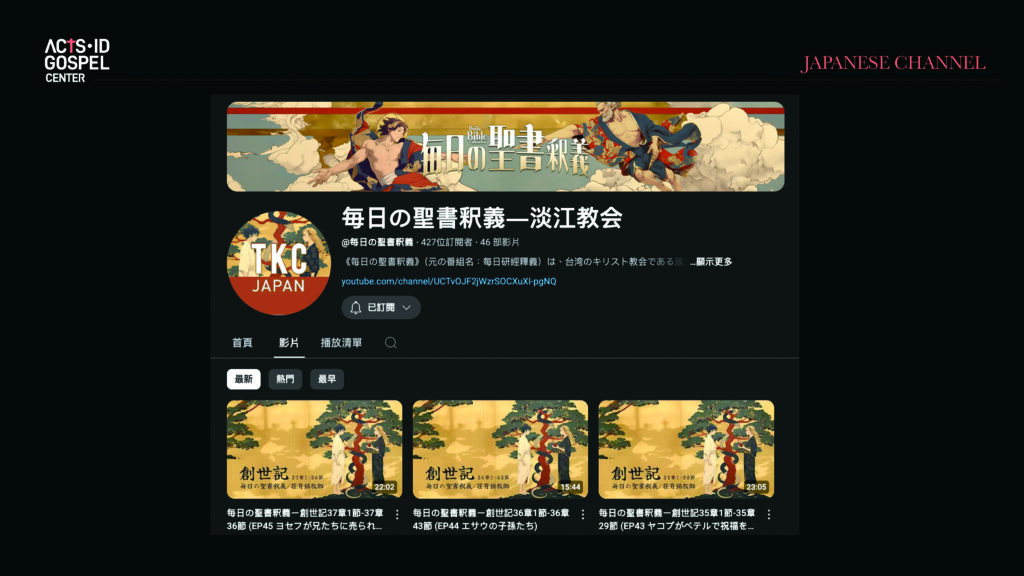

However, Tamkang Church's foresight and proactivity in using AI to spread the gospel far exceeds this. Pastor Huang Xinlei emphasizes: "Tamkang Church's vision is to first develop an AI platform for internal church use, like a Tamkang Church version of ChatGPT and Midjourney.3to assist various church ministries. When the timing and technology become more mature in the future, we are willing to uphold the Kingdom vision and share AI application resources with more churches, regardless of church size, so that together we can receive the blessings God bestows through AI technology!"
If churches want to reach the hearts of Gen Z (approximately born 1997-2012), they must enter their active digital spaces and deliver messages through media familiar to them. Gen Z grew up with smartphones, social media, and short-form videos, and their media usage habits are completely different from the past. For example, they prefer short-form video platforms like TikTok, Instagram Reels, and YouTube Shorts, and have even stopped using Google search engines, tending instead to search for needed information on social media.
Using AI wisely can effectively help churches communicate with Gen Z. For example, it can assist churches in quickly generating multilingual worship songs and sermon summaries, or even converting content into forms that align with local culture, like Tamkang Church's anime-style Bible commentary videos. AI can also help pastoral teams analyze social media data to understand young people's needs and the issues they care about, effectively adjust content strategies, and enhance engagement. Furthermore, AI enables churches to provide more personalized faith resources, meeting Gen Z's need for authenticity and personal connection.
Potential Risks and Adverse Effects
If churches and Christians do not actively keep up with the AI era wave, what negative impacts will result? AI greatly increases the speed and volume of content produced by heretical writers, so it is very likely to "occupy Christian-related forums, blogs, and media on the internet," Elder Jack Pu pointed out earnestly.
What requires even greater vigilance is that since AI large language models are trained based on internet content, the mass production of heretical content will cause future AI model training to learn from this erroneous content, making future generated content "increasingly deviant"!
Through his experience advocating for churches to understand and learn to use AI, Elder Jack Pu has discovered that many churches and pastors do not fully understand AI, worrying about being replaced, weakening the Holy Spirit's guidance, or misleading the congregation with impure content. Or churches lack co-workers familiar with AI—even if they purchase AI tools, they don't know how to effectively apply them to the church's workflow, while also lacking guidelines for AI usage.
In addition to actively seeking co-workers who can use AI, churches also need to establish their own AI guidelines, clearly defining what types of ministry can use it, while respecting copyright and privacy rights, and establishing norms regarding ethics and over-dependence.
After discussing so many possible uses of AI in churches, won't there be adverse effects?
Elder Jack Pu candidly states: "When using AI in churches, adverse effects will certainly occur. Therefore, Christian media can conduct more detailed and comprehensive investigative reports on these adverse effects, which would be of great help to churches!"
Referring to various articles from media and organizations about the adverse effects of AI, it can be found that the main adverse effects AI produces in human society include: replacing human jobs; security issues arising from malicious use, such as using AI for fraud; discrimination; privacy; economic inequality; decline in service quality; over-dependence on AI; reduction in social interaction; only working according to instructions... and so on.4
Consider this: if churches extensively use AI, it may reduce manpower, leading to unemployment for some co-workers. If pastors, co-workers, and believers heavily use AI, they may gradually lose their ability to think, judge, and be creative due to over-dependence. Since AI systems require large amounts of personal data for analysis, this could lead to church member data leaks or misuse. If churches allow AI to take on services previously undertaken by believers, such as personal counseling and care, it may weaken authentic community connections and believers' faith growth experiences through participation in ministry.
Taking Steps with Caution
The first step for churches applying AI, besides establishing correct concepts, is to start with existing workflows. Elder Pu advises: "Don't immediately think about using AI to establish new ministries; instead, consider how AI can help solve existing problems and improve church work efficiency."
Pastor Jiang Bingyi believes churches should start using AI in "areas of greatest need," so that problems can be immediately solved and the congregation can see AI's practical results. For example, social media management, small group teaching material assistance, Sunday school materials and curriculum design, children's songs... and so on. As the church accumulates experience and insights in using AI, it can further allow AI to help pastors think about sermon content from different perspectives (such as the life experiences of specific congregational groups), compensating for pastors' blind spots. However, as mentioned earlier, all of the above applications require joint discernment and adjustment by pastors, elders, co-workers, and church members.
Churches also need to cultivate talent for the AI era, encouraging co-workers interested in AI to learn relevant tools, serving as seed workers or pioneers to drive church adoption. They must also collaborate externally, coordinating with other organizations, seminaries, and churches in a multi-pronged approach, sharing experiences and jointly developing AI tools or applications suitable for church use.
The pastors interviewed repeatedly emphasized that churches must maintain high vigilance and discernment. The key strategy is: God-centered, people-oriented; AI as assistance, not AI dependence. Therefore, priority must be given to authentic interpersonal relationships, theological integrity, sound ethical frameworks, and ensuring that technology serves the church's mission rather than replacing the church's core values.
The AI trend is unstoppable. While being cautious and vigilant, it is hoped that churches and Christians will continue to learn about and use it. Just as Elder Pu Zhengning, Pastor Jiang Bingyi, and Pastor Huang Xinlei unanimously appeal: "Why not take the first step and bravely give it a try!"
Note:
- Seethis magazine's issue 76, Kingdom Neighbors section, article "Using AI for Benefit; Using AI to Glorify God.".
- Tamkang Church YouTube Channelhttps://www.youtube.com/@%E6%B7%A1%E6%B1%9F%E6%95%99%E6%9C%83-%E5%9C%8B%E5%BA%A6%E5%BD%B1%E9%9F%B3/featured.
- Midjourney is a generative artificial intelligence program and service developed by an independent research lab of the same name. Its primary function is to generate high-quality images based on text descriptions (called "prompts") input by users. Readers can think of Midjourney as a powerful "AI artist" that creates stunning visual works based on your descriptions.
- For more concerns and possibilities regarding AI use, please refer toThis magazine's issue 73, Kingdom Stewardship section, article "AI Artificial Intelligence: Past, Present, and Future".
Interviewer:
Timothy currently assists Innodata in content creation and data annotation work for AI/Large Language Models. He is passionate about writing and deeply interested in new technology and AI. He hopes that through writing, he can help churches and Christians use AI reasonably and thoughtfully, making technology an asset for evangelism and church building.