
Sincerity: Choosing the Good and Holding Firm To It
Confucian Tradition's Central Idea is Sincerity
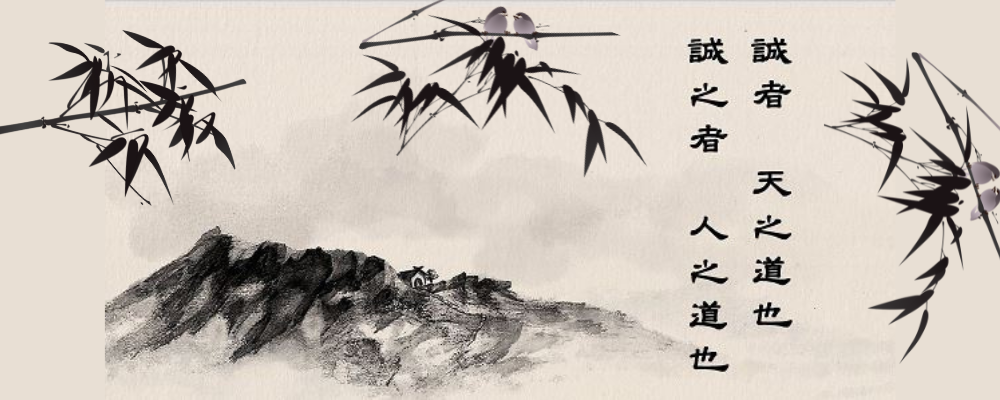
Sincerity is the Way of Heaven; to be sincere is the Way of man. One who is truly sincere hits the mark without effort, understands without thinking, and naturally aligns with the Way — such a one is a sage. One who practices sincerity chooses what is good and holds firmly to it.
"Only those who are utterly sincere can fully realize their own nature. Those who can fully realize their own nature can also realize the nature of others. Those who can realize the nature of others can realize the nature of all things. Those who can realize the nature of all things can assist in the transforming and nourishing work of Heaven and Earth. And those who can assist in the transforming and nourishing work of Heaven and Earth can stand with Heaven and Earth as their equal." (Doctrine of the Mean Chap. 22)
Confucianism continually elevates the concept of "sincerity" (誠)—from peak to peak—until it nearly reaches a metaphysical, even divine, realm. It goes even further: "The Way of utmost sincerity allows one to foresee: When a nation is about to prosper, there will surely be auspicious signs; When a nation is about to perish, there will surely be omens of misfortune. These signs can be seen in divination, sensed through one’s being. When blessings or disasters are about to come, the truly sincere will know them beforehand—both the good and the bad. Therefore, utmost sincerity is like a divine power." (Doctrine of the Mean, Chapter 24) This passage pushes the concept of sincerity to the very edge of the unknown, entering the spiritual or religious realm within Confucian thought.
The Great Learning opens with a clear statement of purpose: “The Way of the Great Learning lies in manifesting one's bright virtue, in renewing the people, and in resting in the highest good.” (On "renewing the people," the Neo-Confucian scholar Cheng Zi interpreted "renewing" [新] as the correct reading instead of "drawing near" [親].) (This is the first chapter of the Classic portion.) These three aims are known as the “Three Guidelines” of Confucian learning. And the key to attaining the “highest good” lies in sincerity (誠): “To be sincere is to choose what is good and firmly hold to it.” But what, then, is “good”? In fact, Confucian thought is not a metaphysical religion. Rather, it is a system of ethical and moral principles meant to be practiced in human society. The ultimate concept of “good” in Confucianism can only serve as an ideal principle—a virtual goal, not an absolute one. This is why, even after thousands of years of moral and ethical discussion within Chinese Confucianism, the actual improvement of human nature has been minimal—and may even be showing signs of decline.
However, this idealized principle of “goodness” in Confucianism can be realized within Christianity. The Confucian ideal of the highest good (zhìshàn) finds its true fulfillment in the Christian faith—where the dream becomes reality.
Human beings, by themselves, are incapable of doing good.
Please reverently read this account from Christ’s earthly ministry: “Now a man came up to Jesus and asked, ‘Teacher, what good thing must I do to get eternal life?’ (Some ancient manuscripts: ‘Good Teacher…’) Jesus replied, ‘Why do you ask me about what is good? There is only One who is good.’ (Some manuscripts: ‘Why do you call me good? No one is good—except God alone.’) ‘If you want to enter life, keep the commandments.’ The man asked, ‘Which ones?’ Jesus replied, ‘You shall not murder, you shall not commit adultery, you shall not steal, you shall not give false testimony, honor your father and mother, and love your neighbor as yourself.’ The young man said, ‘All these I have kept. What do I still lack?’ Jesus answered, ‘If you want to be perfect, go, sell your possessions and give to the poor, and you will have treasure in heaven. Then come, follow me.’ When the young man heard this, he went away sad, because he had great wealth.” — Matthew 19:16–22 This passage also appears in two other “Synoptic Gospels”: Mark 10:17–22 and Luke 18:18–23.
The young man was greatly loved by Christ because from an early age he strictly observed the Law, which was truly remarkable. The commandments the Lord mentioned to him included two aspects: one was a list of negative prohibitions—four consecutive “You shall nots.” Could ordinary people truly keep all these? It would be extremely difficult. The other aspect was positive instructions—two “You shall” commands. In fact, most people cannot even keep these commandments superficially; even if they barely manage, it is very difficult and still only surface-level, not sincere. Therefore, the Lord valued this young man highly because he sincerely tried to keep the outward appearance of the Law. Among many Israelites, few could meet this condition. But was this enough to be “perfect”? Certainly not. The Lord further told him that if he wished to be “perfect,” he must sell all he owned and give to the poor—this is the positive fulfillment of “love your neighbor as yourself.” Could he do that? The young man found it very difficult because he was very wealthy. His possessions became a burden. Moving earthly treasures to heaven is an extremely hard thing to do. “Good deeds”? They become mere words—easy to say, but hard to do. Therefore, whether outwardly or inwardly, he was unable to be truly moved.
What Christ mentioned were all essential requirements of the commandments, showing that the commandments and the Law are fundamentally impossible for people to fully keep. People are therefore far from truly doing “good deeds” and from attaining eternal life—it remains utterly out of reach. In reality, the only function of the Law is to reveal people’s moral shortcomings—that is, their sin. Thus, if a person tries to seek the ultimate good by following the path of the Law, it is like climbing a tree to catch a fish: hopeless and futile. So, what can people actually “do”? The truth is, people cannot do any truly good deed; no matter how much or how well they try, it is all in vain. The Lord told the young man that the only thing he could do was to sell all his possessions and give to the poor—this was the minimum “good deed” he could perform. If he couldn’t even do this, how could he possibly take up his cross and follow Christ? In the end, the young man went away sorrowful and troubled. Where did he go? Surely not the path to eternal life he had initially imagined—it was likely the exact opposite direction.
The young man first asked Christ only about “what is good,” which reveals something important: he did not truly understand what “good” really is. Secondly, he tried to achieve the goal of “goodness” by his own effort. Both of these were major mistakes, as neither approach works. Although his starting point was good, unfortunately he took the wrong path and went further and further astray. If a person wants to reach the goal, they must first find the right direction before they can seek eternal life.
Entering eternal life through justification by faith.
Now, let us return to discuss the “choosing good and firmly holding to it” in Confucianism, specifically the concept of “good” (善), which bears a strong resemblance to the young man’s understanding of “good”: both have mistaken the true goal. When the goal is already wrong, the methods will naturally be wrong as well. The “good” in Confucianism is merely an idealized goal or a beautiful wish. This young man was a descendant of God’s chosen people—the Israelites. How could a descendant of the chosen people lack a correct goal?
Of course he did. Pursuing “eternal life” was his goal (just as many people believe in Jesus only to go to heaven). In the young man’s fixed mindset, the commandments and the Law were the most important. He thought it was enough if a person could keep them outwardly. And if that still wasn’t enough to earn eternal life, then of course one could try harder. By doing more good deeds, he believed he should be able to earn eternal life.
This is adding an extra layer of insurance beyond simply keeping the Law — something Martin Luther firmly opposed: the idea that people can be justified by their “good works.” Can humans truly perform genuine good works? No matter how much or how hard they try, people cannot perfectly keep the Law. The Lord told the young man, “You still lack one thing” (Mark 10:21), because humans will always fall short and never meet God’s standard of the Law—they will always lack something. Only Christ’s sacrifice on the cross, and the precious blood shed from God’s only begotten Son, can satisfy all the demands of the Law and the commandments. Eternal life cannot be earned by good works; it is freely given because Jesus Christ gave His life for us. Anyone who believes and accepts Christ as Savior can be justified freely (Romans 3:28, Revelation 21:6). “Eternal life” is not something to be “earned,” but something to be “entered into.” It is a state of being, and anyone who meets the requirement of “justification by faith” can enter it. This young man was tragically mistaken.
True goodness comes from the self-sacrifice of the Lord Jesus.
The Confucian “Three Guiding Principles” aim to “reach the highest good.” This ideal is lofty, but one must first fully understand: what exactly is “good”? If “good” is treated like a distant, unreachable flickering light, it will forever remain beyond grasp. “‘Sincerity’ means choosing the good and holding firmly to it.” However, if a person lacks the ability or knowledge to choose what is truly good, then “holding firmly” becomes nothing more than empty talk.
In fact, “good” is not merely a beautiful wish, an ideal, or a principle. “Good” is the Creator of all things in the universe and the Redeemer who sacrificed Himself to save humanity. “Good” is a personal God—Jesus Christ. It is not people who choose God, but God who chooses people. God takes the initiative; humans are passive recipients. If this is reversed, everything turns out contrary to God’s design.
Confucianism’s concept of the “highest good” (至善) is “sincerity” (誠), which it elevates to a metaphysical, first-cause divine realm. This “sincerity” corresponds exactly to what Christ called the “greatest truth” in the Bible: “Let your ‘Yes’ be ‘Yes,’ and your ‘No,’ ‘No’” (Matthew 5:37). Christ Himself is the “Yes” (the embodiment of sincerity). “Is” (Yes) is another title for Christ because He alone is the highest good and sincerity, as well as the Creator and Redeemer. Therefore, only those who believe in Him (Christ) can have eternal life (John 3:36) and can even possess eternal life in this present world (John 3:15-16).
In summary, we gain an important insight: God first chose the nation of Israel to carry out His salvation plan that He had ordained since the creation of the world. Although this nation repeatedly rebelled, God’s hand continually disciplined them. Because of God’s steadfast choosing, the Messiah Savior was finally incarnated and born among the descendants of David, the offspring of Israel. He became the Messiah who ultimately fulfilled God’s will—this alone is the true “good” to be chosen and held firmly to. Therefore, the Confucian saying could be revised as: “The sincere person is one who chooses the ‘good’ and holds firmly to it.”

Author Bio:
Yin Ying is a passionate lover of nature and a writer who praises the Creator. She is also an editor, publisher, and communications professional. Her essays have been adopted as textbook content in various Chinese-speaking regions.