

Male-Female Partnership and Alliance as Seen Through Character Portrayals in the Book of Judges
Narrated by Chloe Sun
Organized by Linda Pang
Video by Fullness in Christ Fellowship
Moral Decline in Chaos
The Book of Joshua records how the Israelites, after entering Canaan, conquered the land, divided it, and received their inheritance. The Book of Judges reveals that there was still unconquered territory; it was a chaotic period without a king; and it served as a transitional period before entering David's prosperous dynasty. The entire book contains 21 chapters, and from chapter 17 onward, it mentions four times "In those days Israel had no king; everyone did as they saw fit" (cf. 17:6; 18:1; 19:1; 21:25).
Summarizing the Message of Judges with Four S's:
Sin — Idolatry;
Servitude — Oppression by Foreign Nations;
Supplication — Crying Out to God;
Salvation — Raising Up Judges for Deliverance.
The delivered Israelites fall again into the cycle of sin, oppression, crying out, and deliverance, becoming more corrupt with each successive cycle.
Moses led the first generation of Israelites out of Egypt, Joshua led the second generation of Israelites into Canaan, and the period of the Judges represents the situation from the third generation onward—which can be described as a failure in faith transmission. Can the Book of Judges inspire today's Chinese churches in North America, Europe, and other regions—many of which consist largely of immigrants—to continue transmitting and preserving orthodox faith beyond the first and second generations of believers?
The literary design of the Book of Judges also offers spiritual insights. The six "major judges"—Othniel (tribe of Judah); Ehud (Benjamin); Deborah (Ephraim); Gideon (Manasseh); Jephthah (Manasseh); Samson (Dan)—when viewed by the geographical locations of their respective tribes, follow a pattern from south to north, from Judah to Dan; it seems as if they are moving progressively farther away from the tribe of Judah as the model.
Among them, Othniel had no apparent flaws; Ehud was "left-handed" (with a withered right hand); Deborah was the only female judge; Gideon lacked faith; Jephthah sacrificed his daughter as an offering and also displayed faith issues in his process of leading Israel; Samson could not overcome his weakness for beautiful women and failed to observe the Nazirite vows. The recorded passages become progressively longer, yet the problems become increasingly severe.
This transitional and dark period of history still speaks to Christians today. From the vivid portrayals of male and female roles, we can see irony and reversal techniques. Let us reflect on male-female partnership and alliance through the chapters that reflect Israel's gradual moral and spiritual decline, examining together Achsah the daughter of Caleb; Deborah and Jael who killed the Canaanite general Sisera; and the Levite and his unnamed concubine.
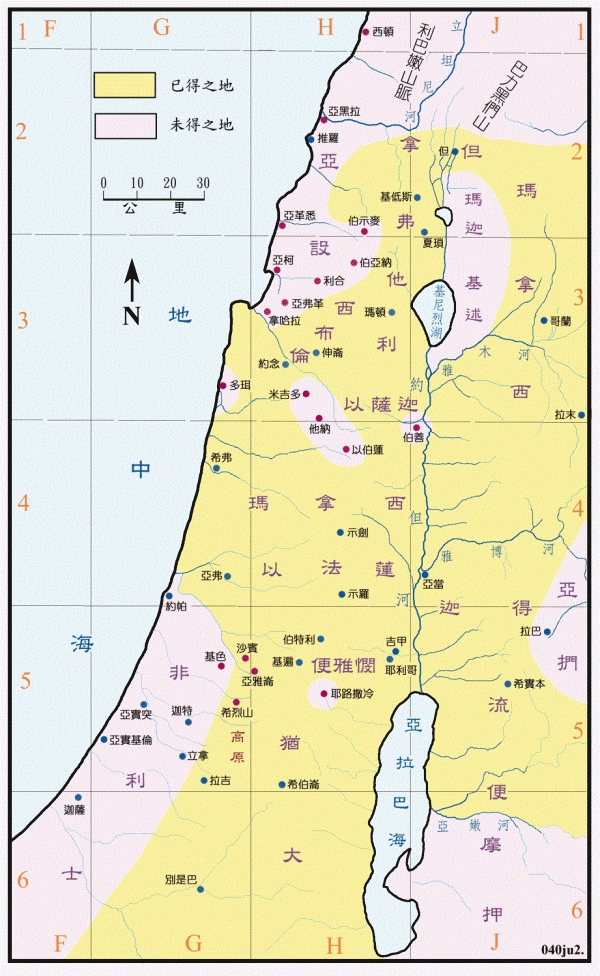
▲ Image source:https://biblegeography.holylight.org.tw/index/condensedbible_map_detail?m_id=040
Achsah's Autonomy (Judges 1:12-15)
Caleb, who was still expanding territory, announced before capturing the city that he would give his daughter Achsah as a reward. Othniel, also from the tribe of Judah, took the city and was thus able to marry Achsah. Achsah's status as a daughter meant that while she received her father's protection, she had no voice in the matter of marriage and could not challenge her father's decision.
When she married, she "urged her husband to ask her father for a field," which meant obtaining an inheritance. Achsah did not ask her father directly, but rather went through her husband. Perhaps the field she requested was one of the spoils of war from the captured city, or perhaps she possessed high emotional intelligence, believing that her father would be more likely to grant her husband's request for the field. She not only knew what to ask for, but also knew how to ask and who should do the asking, which made success more likely.
Upon seeing her father, she "got down" from the donkey. The Hebrew word used for "down" has the same meaning of "sinking down" as in chapter 4, verse 21, where Jael drove the tent peg "into" Sisera's temple and into the ground. Through the body language of kneeling or prostrating, she made her father aware that his daughter had a request.
Achsah asked her father to "give her a blessing," which can be understood as a gift serving as a dowry. The city that Othniel captured, which would thereafter be Achsah's place of residence, was in the arid "Negev," unfavorable for farming. Achsah wisely requested not only the field but also springs of water. And her father Caleb gave her both the upper and lower springs, exceeding what his daughter had asked for.
Numbers 27 and 36 also record the daughters of Zelophehad from the tribe of Manasseh requesting an inheritance. They believed that if their father had no sons, the inheritance should be passed to his daughters. They appealed to Moses and the leaders, and Moses brought the matter before the LORD. God replied: "What Zelophehad's daughters are saying is right."
Regarding Achsah's request for springs of water, interpretations have always been polarized: one side sees her as a spoiled daughter who, after getting the field, pushed her luck further by demanding springs; the other side sees her as taking initiative with a humble attitude. The word "urged" that Achsah used with her husband Othniel also appears in the book of Job, where Satan "incited" God to attack Job. Although we don't know specifically how Achsah "incited" her husband, her actions had good results.
The art of Achsah's petition reminds us: she lived in a patriarchal era, just as many Chinese female Christians and ministry workers find themselves in male-dominated church cultures. In a patriarchal society, Achsah knew how to "urge" her husband to "ask" her father. She transformed her passive situation into an active one; in decisions where she could not participate, she still autonomously sought her rights.
Can sisters clearly understand their rights in interpersonal relationships and know how to petition those in authority with wisdom and humility? Do they dare not ask or request due to fear of authority figures, thus limiting their ministry? And what can they ask of God and of people? Whether it's opportunities for teaching, preaching, ordination, or finding ministry partnerships—as long as it can make ministry more effective and impactful—we hope they can all learn the wisdom of petition.
A publishing house once included my bio in a book, listing only my administrative role as Associate Director of the seminary research center while omitting my teaching position as Professor; yet teaching theology is my calling and the focus of my ministry. I reflected: Should I point this out? And how should I communicate with the publishing house staff? Handling it with anger or threats would be unhelpful and would damage relationships.
In the email, I first congratulated them on the book's publication and affirmed the value of this book for edifying believers. Then I pointed out the oversight and suggested corrections for the next edition. This was my learning and practice in the art of petition!
The Partnership of Deborah and Jael (Judges 4-5)
When Deborah appeared on the scene, she was a prophetess, holding the same position as Moses, Samuel, and others; she was also a wife, under her husband's protection. For today's female ministry workers, the roles of wife and mother bring corresponding experiences and perspectives that perhaps can make ministry broader. However, in male-dominated ministry fields, these roles may also become "add-ons" and may come with other limitations.
The two judges Othniel and Ehud began with "the LORD raised up," but Deborah did not have this phrase. At that time, the Israelites came to the tree named after her to hear her "judgments," showing her ability and the respect she received. Perhaps another way God "raised up" judges was through the faith community's recognition of her person and gifts.
Deborah conveyed God's revelation to Barak, a capable warrior who could lead troops in battle. However, Barak, whose name means "lightning," seemed to always be a beat slow in his actions. He replied: "If you go with me, I will go; but if you don't go with me, I won't go." Some see Barak as childlike, dependent on Deborah as the mother of Israel (cf. 5:7); others believe Barak respected and was willing to submit to Deborah's leadership. This reverses the image of the judges both before and after him.
In the narrative of Barak's defeat of Sisera, Jael appears in the tent as a traditional wife figure. She welcomed Sisera into the tent, covered him with a blanket, and "gave him milk to drink," like a mother's protection and care for her child. Jael's killing of Sisera with a tent peg represents a reversal of roles between the mighty general and the weak woman, fulfilling Deborah's earlier prophecy: "the LORD will deliver Sisera into the hands of a woman."
In the song of chapter 5, when "the leaders ceased," Deborah became the mother of the nation. In verse 12, we see Deborah taking the lead with Barak in a supporting role. Beginning from verse 24, there is a more detailed description of how Jael killed Sisera.
The partnership between Deborah and Jael is demonstrated in how they each fulfilled their roles, transcended traditionally assigned roles, and complemented each other—Deborah as prophetess and judge; Jael as the one who killed the general, becoming a warrior. Deborah composed a song to praise the LORD and also celebrated Jael's courage and wisdom. This reminds today's female ministry workers to each fulfill their roles and partner with one another; those with deeper experience should support those with less experience, commending and affirming them.
Deborah held multiple identities as prophetess, judge, leader, wife, mother, and poet; Jael was both a wife and a female warrior. This encourages ministry workers to embrace their multiple identities and utilize their various gifts. The text mentions the names of Deborah's and Jael's husbands but records nothing about what they did. For women called by God who are able to serve effectively and powerfully, there is usually a supportive husband behind them; the husband also partners with God through this support.
Barak obeyed the revelation that came from Deborah, and the two led the army to attack the enemy, then composed a song together with Deborah afterward. From this we can see that he accepted his ministerial position and limitations, respecting women's leadership in ministry. This is an image of male-female partnership and alliance.
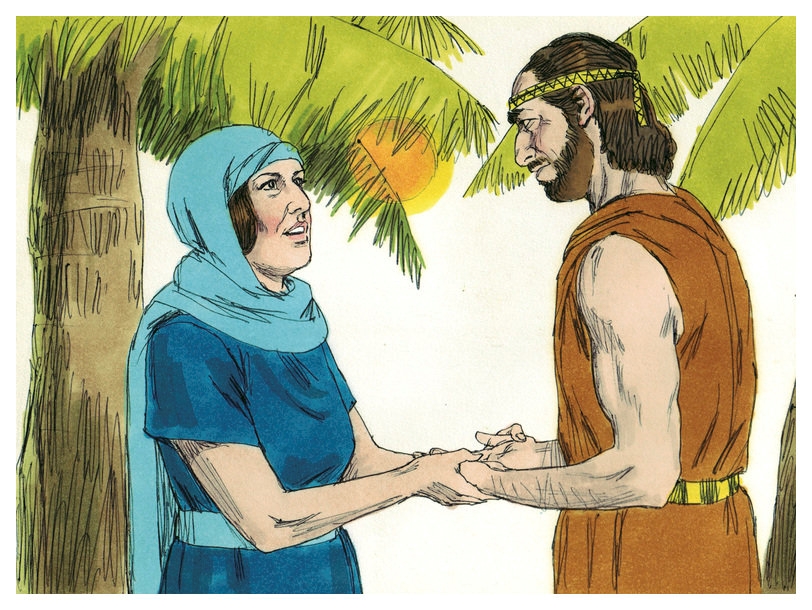
▲ Image source:https://commons.wikimedia.org/wiki/File:Book_of_Judges_Chapter_4-2_%28Bible_Illustrations_by_Sweet_Media%29.jpg
The Levite and His Silent Concubine (Judges 19)
Judges 17-21 records the corruption of the Levites, symbolizing the corruption of the priestly system; moral decay reflects the dark spiritual condition.
Chapter 19 mentions again that Israel had no king. The Levite, who should have been the husband of only one woman, had taken a concubine, and after the concubine left home, the husband waited four months before going to retrieve her. On their journey home, they arrived at Gibeah where the Benjamites lived and received hospitality from an old man. That night, wicked men demanded to have sexual relations with the guest, the Levite, but the old man offered his own daughter and the Levite's concubine in exchange, saying they could "do whatever seems good" to them. This familiar incident occurred in Genesis 19, where the Benjamites of Gibeah resembled the heavily sinful people of Sodom.
The Levite pushed his concubine outside, causing her to be abused by the mob all night until she died. Afterward, the husband cut her body into 12 pieces and sent them throughout the territory. The Israelites from north to south "came together as one man" to attack Gibeah, nearly wiping out the entire tribe of Benjamin, with only 600 men remaining who took refuge at the rock of Rimmon.
The text is filled with noise and violence, but the unnamed concubine is never heard speaking a word. Though she had a father and husband, she received no protection; from beginning to end she was a powerless, passive, vulnerable victim. The author uses the way men treated vulnerable women—the conscience-seared old man, the Levite, and the men of Gibeah—as a standard for measuring morality and spirituality.
Beginning with the violence of foreign oppression and ending with Israel's violence against their own people, Judges concludes with "In those days Israel had no king; everyone did as they saw fit (did what was right in their own eyes)."
What did the silent concubine say? Who are the voiced and voiceless in ministry? Is their silence due to positional or institutional limitations, or individual leaders' theological viewpoints? Is it due to tradition, or their own timidity? Can those among us who have a voice enable the voiceless to speak?
The Latin roots of both "voice" and "vocation" are related to calling. Can the voiceless exercise the voice of their calling? Do those who have a voice also possess spiritual discernment, through prayer and spiritual companions, to discern when to speak and when to remain silent?
A church once invited me to lead an entire weekend Bible seminar, including the combined Sunday school on Sunday. When worship time came, in the same space, only men were permitted to preach. Out of respect for the church's tradition, I did not raise any objections. However, the Cantonese congregation of the same church gave me the opportunity to preach in Cantonese. This was an experience of a time to be silent and a time to speak.
Theological Message and Impact
The Book of Judges reflects how the Israelite nation at that time, amid the chaos of "everyone doing as they saw fit," longed for the rule of a better king.
Connecting the kingless period of Judges and the beginning of the monarchy recorded in Samuel is the Book of Ruth, a book centered on women (Naomi and Ruth). The male character (Boaz) is very positive, treating Naomi and Ruth with respect, and ultimately becoming their "redeemer," serving as an example of male-female partnership and beautiful collaboration. The Book of Ruth becomes a contrast to Judges, correcting the errors of Judges.
Samuel and Kings are historical books centered on male monarchs, yet they begin with Hannah, the mother of the prophet Samuel, as the leading figure. She prayed to God for a son and dedicated Samuel to Him, representing a God-centered spiritual portrait that seems to become a model for kings, highlighting that "to obey is better than sacrifice."
Naomi, Ruth, and Hannah can be seen as a reversal of the treatment of women in the final chapters of Judges. Samson wanted to take a Philistine woman as his wife, and his reason was: "I am pleased with her." (NET) The word "pleased" (translated as "delight" in other versions) literally means "she is right in my eyes." The phrase "everyone did as they saw fit" in the time of the judges is literally "everyone did what was right in their own eyes"; Samson was a reflection of the hearts of people at that time.
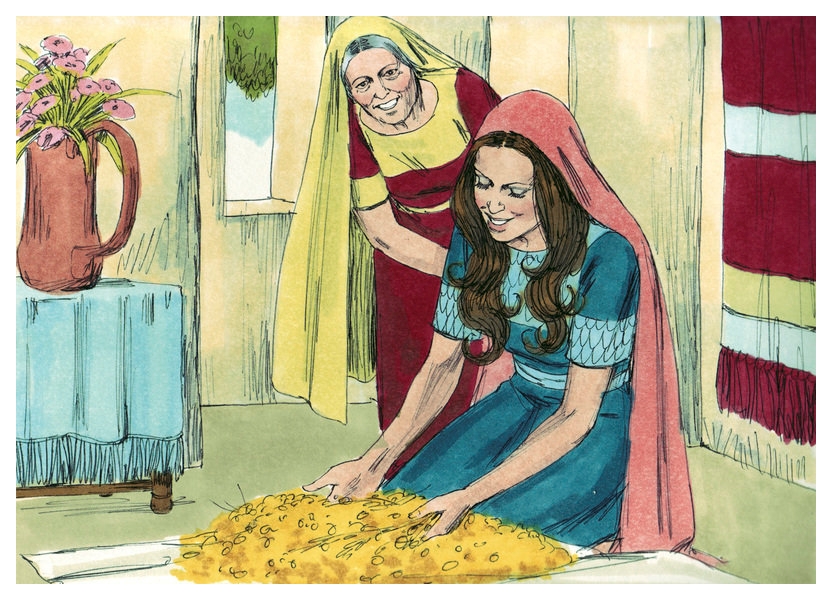
▲ Image source:https://commons.wikimedia.org/wiki/File:Book_of_Ruth_Chapter_2-9_%28Bible_Illustrations_by_Sweet_Media%29.jpg
David is known as "a man after God's own heart," but he was not perfect, having committed the serious sins of adultery and murder; because of God's election, he was still "after God's heart." The standard in Kings for measuring kings is whether they "did what was right in the eyes of the LORD." This reminds us today that when "everyone does as they see fit," we too will fall into the chaos of the period of the judges.
Among Achsah, Deborah and Jael, and the Levite's concubine, which character do you most identify with? What reminders about male-female partnership and alliance can be gained from these character portrayals?
Both men and women need to recognize their calling and gifts, and also accept their limitations. God has not given any one person all gifts, because He wants us to support and complement each other. Ministry workers also need to examine their theological positions—are there biases regarding male and female ministry due to tradition or one-sided interpretation of Scripture? Can we understand truth with a broader perspective, view fellow believers, and participate in the kingdom? And in understanding and practicing truth, do we measure by "doing what is right in the eyes of the LORD"?
I believe that male-female partnership and alliance ministry teams that are after God's heart will enable the church as the body of Christ, as well as His kingdom, to become more abundant and grow more healthily.
Thank you to Flourishing Fellowship for providing the lecture recording. Please visit the Flourishing website to watch the complete video.

Author Bio
Dr. Chloe Sun, previously taught Old Testament at Logos Evangelical Seminary. She is currently Professor of Old Testament and Program Director of the Chinese Studies Center at Fuller Theological Seminary.