
Striving to Excel — From Efficiency to Effectiveness, From Self to Team, From Pain to Joy
[Workplace Habits] Series ❸
Doing a job poorly ≠ lacking ability
After spending some time in the workplace, most people become more efficient in how they work. At this stage, we need to remind ourselves that efficiency alone is not enough—what matters more is achieving real results. In fact, the key to whether a person can steadily move up the career ladder lies in how bosses and clients perceive our work outcomes; and what shapes that “perception” is not merely professional or technical ability.
Many people in the workplace feel that they have already learned every theory there is to learn—that they understand everything they’re supposed to—yet they still find themselves unable to put those theories into practice. It is like the poet Xi Murong's line quoted in the film “The Continent": “Though we’ve heard many truths, we still fail to live this life well.”
Why is it that we cannot fully apply the principles and knowledge we’ve learned? One important reason is this: work outcomes are not determined solely by our abilities; they are also constrained by our capacity to manage expectations. Here is a simple formula for reference—
Emotional Reward = Work Capability × (Results − Expectations)
For example, on a typical workday we get up early, eat, go to work, and then interact with clients, colleagues, and bosses while handling various tasks. Throughout this process, our physical and emotional energy is like a phone battery—it starts the day at a full five bars, but with every conversation, problem solved, and negotiation joined, the “power level” gradually drains until there is little left.
So, what exactly causes the emotional “battery drain”?
Many times, colleagues and bosses do recognize our work capability. However, once there is a gap between the “results” produced and the expectations set, people’s feelings tend to turn negative. For example, we may promise a client delivery within one week, but due to various unexpected issues, it ends up being delayed by a day or two. The client will inevitably complain, or even question our competence. Situations like this drain both sides’ physical and emotional energy.
Our emotions—and those of our clients—are not determined solely by our work capability. What truly affects emotions at such moments is the gap between expectations and actual results. This gap shapes how clients, bosses, and we ourselves evaluate our performance, creating a sense that the job has not been fully accomplished, and thus generating emotional pressure. In reality, delays in progress often result from an earlier underestimation of the project’s difficulty, which leads to expectations being set too high—thereby producing a discrepancy between what was expected and what was delivered.
Therefore, people in the workplace must learn to manage both their own expectations and those of others in order to enhance job satisfaction. For example, if a task is originally estimated to take five days, it can be wise to set a more flexible deadline and tell clients or bosses that delivery will take seven days. In this way, even if the task is completed on the sixth day, it still exceeds expectations.
When one’s career development reaches the stage of striving to excel, it is not only IQ (Intelligence Quotient) that matters—EQ (Emotional Quotient), HQ (Health Quotient), and SQ (Spiritual Quotient) are equally crucial. Only by developing the whole person—our abilities as well as our passions—can we sustain the motivation to walk the vocational path for the long run.
More money ≠ fulfillment
Career advancement cannot rely solely on professional skills; likewise, a high income is not a necessary condition for a fulfilling life.
In 1979, Daniel Kahneman and Amos Tversky applied psychological research to economics and proposed "Prospect Theory" (Figure 1): the psychological satisfaction people derive from money is not linearly related to the amount of money they possess.
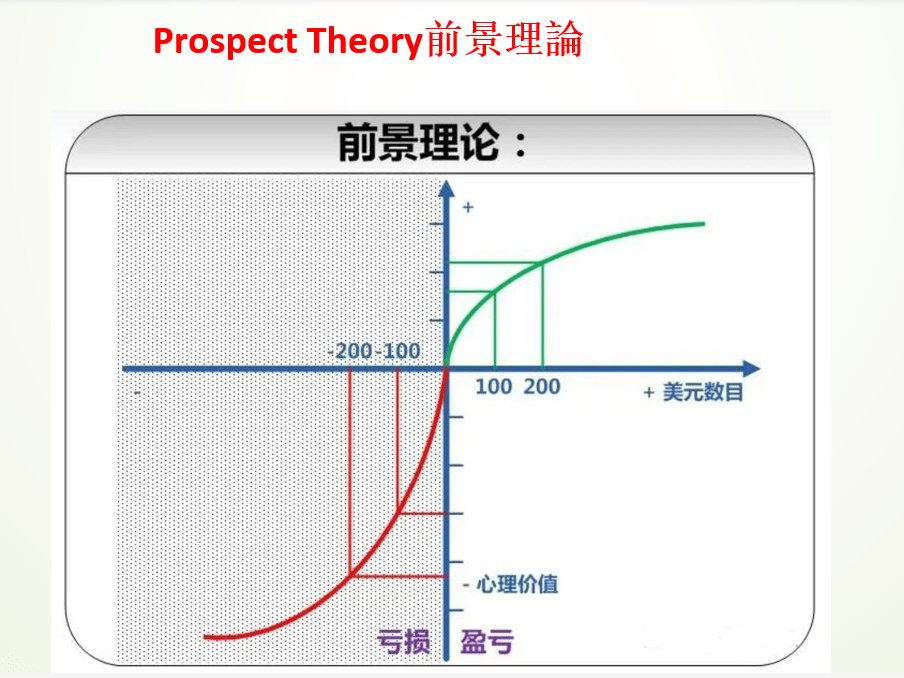
Suppose when a person earns their first million, the sense of value they feel inside is 170; when they earn two million, that sense of value rises to only a little over 200—it does not double. In other words, as one gains more money, the inner sense of satisfaction does not increase proportionally. Beyond a certain level of income, the effect of additional earnings on one’s sense of happiness gradually diminishes, eventually becoming negligible.
Prospect theory further points out that people’s reactions to losses are stronger than their reactions to gains of the same size. In other words, the pain of losing 100 dollars far exceeds the pleasure of gaining 100 dollars—this is known as “loss aversion.”
In addition, Professor Kahneman’s research reveals the phenomenon of “reference dependence,” meaning that when people evaluate their own success, they often use others as a reference point. If they earn more than those around them, they may feel satisfied—even if their overall income is not particularly high.
Research related to prospect theory reminds professionals across all fields that in pursuing career development, money must not be treated as the sole objective. Otherwise, the sense of value one derives from work will be limited and fragile. Only by seeking holistic growth—physically, emotionally, and spiritually—can one truly experience fulfillment and joy in work.

Reset The Anchor Point
In fact, the psychological impact of increases or decreases in income depends on the expected “anchor point.”
How can we reset our anchor point to make our career journey happier? Suppose that when we first enter the workforce, our anchor point is zero—positioned at the origin where the horizontal and vertical axes intersect. If we earn one million in our first year, we feel extremely happy. In the second year, if our income rises to 1.2 million, we are still pleased—but not as happy as in the first year, because by then the anchor point is no longer zero, but one million.
If we can set our “anchor point” in the negative, then every gain we receive will generate a positive sense of value. This is the deeper meaning behind this statement:
“For we brought nothing into the world, and we can take nothing out of it. But if we have food and clothing, we will be content with that.”
This is a healthy way of thinking. It applies not only to gains and losses in money, but also to other areas of life—including promotions or demotions, and the closeness or distance of relationships. When the anchor point is set at having nothing, then everything gained afterward becomes something to be grateful for.
In the Parable of the Prodigal Son in the Gospel of Luke, the younger son, at the end of his rope, returned home in shame. To his surprise, his loving father had been longing every day for his lost son to come back. When he saw the prodigal return, he was not angry at all—instead, he was overjoyed. The father said that this son was lost and is found, was dead and is alive again, and was worthy of great celebration.
Indeed, the joy of “losing and then regaining” far surpasses the joy of simply “gaining.” In the workplace, we might intentionally set our inner anchor point in the “negative”—seeing ourselves as if we originally had no job, and that everything we have today is an extra gift. In this way, we can devote ourselves to our work each day with a heart of gratitude.
At the same time, we should help our bosses and clients reset their expectations of us: we will give our very best in our work, but the results are not entirely within our control. We should also avoid overpromising. When making plans, allow more buffer in the timeline and appropriately lower expectations. Even if we deliver the same work outcomes, they will feel that our performance has exceeded expectations.
By helping ourselves and those around us adjust our psychological anchor points, we come to realize that we originally had nothing. The fact that we are still alive today, with the courage to work hard, is already something profoundly worth being grateful for.
From Self to Team
To advance further in one’s career and become a leader, one cannot rely solely on individual effort. It is necessary to shift from depending on personal ability to embracing teamwork—collaborating with clients, supervisors, and colleagues to achieve shared goals.
In my career, I’ve found that while many people work in sales, those who truly have the ability and skill to do it well are not common. Those who genuinely earn clients’ trust and build long-term partnerships are people of proven character and reliability.
In our work, beyond completing our own tasks, when we can also help clients better accomplish their goals and responsibilities, we earn their trust—and our work naturally stands out.
For example, in meetings with clients, instead of constantly emphasizing how outstanding our products and services are, we should ask about their needs: What goals do they want to achieve? In which areas do they hope to see growth, and by how much? The focus is not on “selling products,” but on becoming long-term partners—building a lasting relationship between both parties.
Professionals should not adopt this attitude only when facing clients; they should also strive to build the same kind of mutual trust in their internal collaboration with supervisors and colleagues.
As citizens of the Kingdom working in the marketplace, we must often remind ourselves: we are not merely working for a company. Our professionalism, diligence, expertise, ethical standards, and our willingness to help others accomplish their tasks all become our personal brand.
For professionals, the greatest value of the “Johari Window” (Figure 2) lies in helping us understand the four quadrants of our presence in society, the workplace, and interpersonal interactions—enabling us to discover our potential and achieve higher career goals.
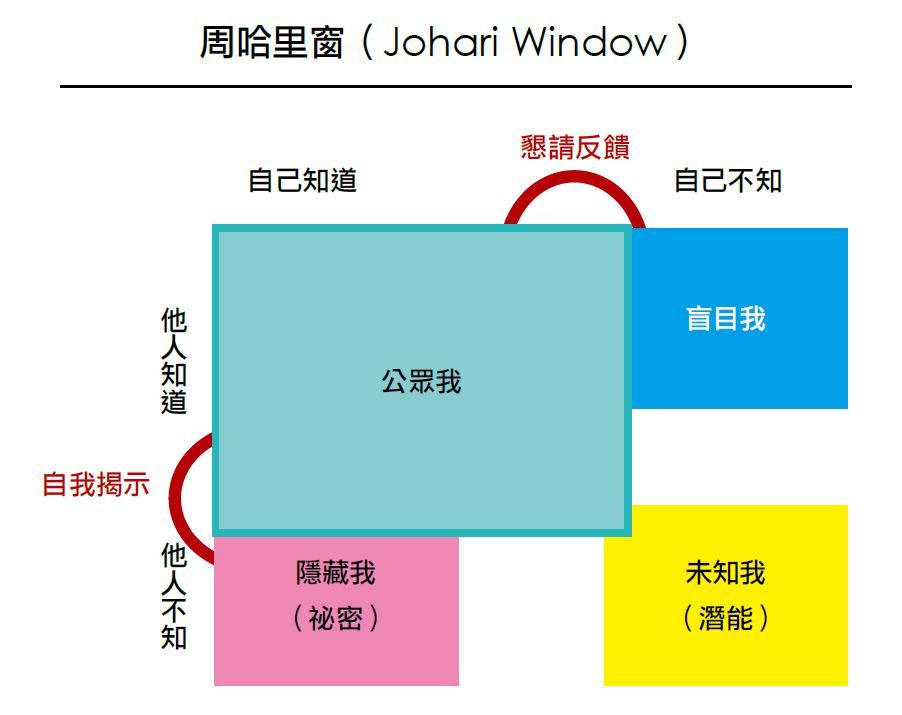
First, through “self-disclosure,” we share personal information with others, thereby expanding the “open area.”
Second, actively seek feedback from others to reduce your “blind spot” area.
By expanding the “Open Self” area through self-disclosure and seeking feedback, our potential can be more fully realized. We are then able to collaborate with more people, harness the power of the group, and achieve higher career goals. This is the most important value of the Johari Window theory for professionals.
Career G.P.S.
In English, if you turn the ‘M’ in “ME” upside down, it becomes a ‘W'. When ”ME“ becomes ”WE“, the situation is transformed—from relying on the individual to working in team collaboration, even to the point of becoming a leader of the team.
As Proverbs wisely says, “Though one may be overpowered, two can defend themselves; a cord of three strands is not quickly broken.” A team is like that threefold cord.
At the stage of striving to excel in the workplace, we need to learn to view issues from the perspective of “we.” By drawing on the support of teachers, coaches, mentors, and sponsors—and by building trust and collaboration across workplace relationships at every level—we gain added strength in our work.
Traveling, driving, and sailing all require a GPS navigation system; a career journey is no different. It helps professionals stay focused on their goals and avoid the many hazards along the way.
G: Goal. Only under the guidance of clear and measurable goals can we have a definite direction for action.
P: Partner. Let colleagues, supervisors, and clients become workplace partners. By using the “Johari Window” for deeper interaction, proactively seeking help, and uncovering our blind spots, we can find assistance and support at every level of our career development.
S: Small Win. Build momentum by accumulating small wins. Consistently nurture relationships with bosses, colleagues, and clients in steady, ongoing ways. Strive to make progress in each day’s work, experiencing small senses of achievement. Over time, these accumulate into milestones along the journey.
In the course of career development, as our abilities grow stronger and our influence gradually expands from the individual to the team, we will inevitably encounter bottlenecks—how can we break through them?
From Pain to Joy
In the workplace, everyone hopes to achieve great things and enter the “elite tier.” But after much effort, one may discover: others all seem more “capable” than I am. No matter how much is invested, the returns never feel equivalent. Life begins to feel meaningless, and work seems to have no value. If striving harder makes no difference, one might as well give up and lie flat. This mindset can be called “learned helplessness.”
Psychologists have found that when people are repeatedly struck and hurt in a particular environment—when their efforts and attempts never seem to yield results—they may develop a sense of helplessness, even choosing to give up and stop taking any action to change their situation. Indeed, in a highly competitive, pressure-filled environment, when one feels unable to prevail, the inner drive to keep striving can gradually be lost.
As mentioned earlier, human nature tends to prefer staying within the comfort zone. If we remain there too long, we may lose the motivation to move forward. When the external environment deteriorates, excessive comfort can become a danger.
To overcome a workplace reality where the only perceived options are either “over-competing” or “lying flat,” we must first intentionally find a higher purpose for our lives. Under the guidance of this purpose, we can step out of our comfort zones and venture into unknown territory.
One study categorizes motivation into four directions: internal, external, positive, and negative. If the drive to do something comes from inner enjoyment or a sense of fulfillment, that is positive internal motivation; if it comes from fear of punishment, it is negative internal motivation.
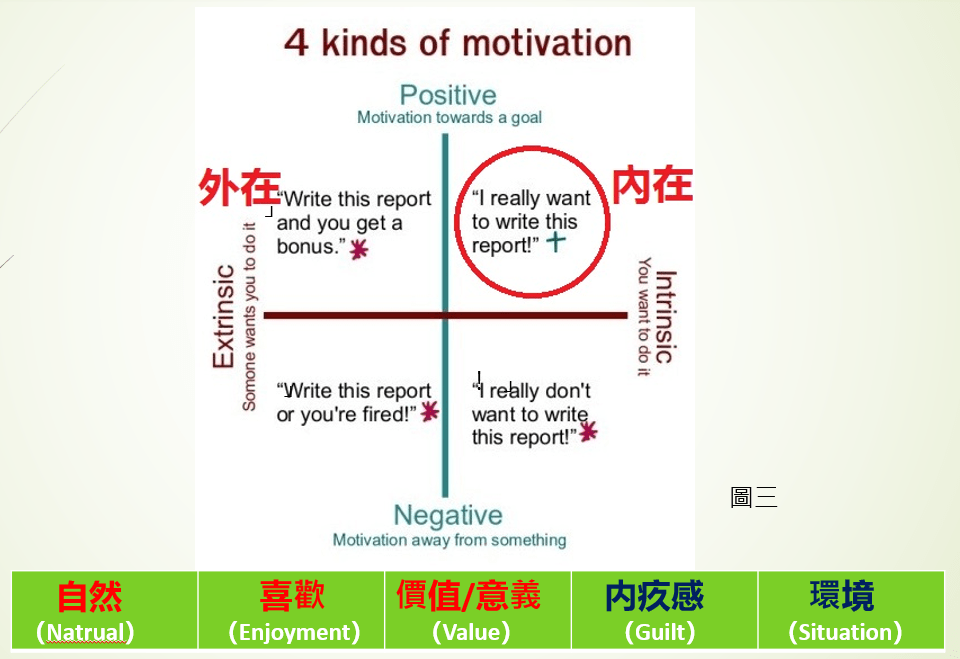
Building on this four-quadrant framework, motivation can be further divided into five categories: 1. Nature; 2. Interest; 3. Value / Sense of meaning; 4. Guilt; 5. Environment. The first three are positive drivers, while the latter two are negative drivers.
So-called “natural motivation” arises from one’s innate disposition; we continue the activity because it feels natural, making it easy to persist. “Interest / enjoyment-driven motivation” comes from having positive feelings toward certain activities and taking pleasure in doing them. “Value / meaning-driven motivation” sustains an activity because we cherish and identify with its importance—so much so that we willingly persevere no matter how difficult it becomes. If failing to do something makes us feel shame, guilt, or anxiety, and we act only out of reluctance, this is “guilt-driven motivation.” If we do something because people around us expect it, and the broader environment treats it as the norm—leaving us little choice—this is “environment-driven motivation.”
In the course of career development, it is essential to clarify our motives for what we do—to understand what drives our hard work, align it with the meaning of our lives, and take responsibility for it.
Here we introduce the 5A Action Framework, in the hope that it will help everyone walk a joyful path in the workplace.
Accountable. Take responsibility for your own life, rather than living merely to meet the expectations of parents, society, or others.
Aware. Regularly reflect on whether the motivation behind our specific behaviors comes from within or from external sources—whether it is positive or negative.
Anticipate. Use positive drivers to fill your inner life with anticipation and hope.
Action. Only by taking proactive action can we truly understand our inner drivers; through practice we discover what brings us fulfillment and joy. No goal can be achieved overnight, so the value of action lies in perseverance. It is helpful to follow the T.E.A. “Cup of Tea Principle”—Tiny: start small; Enjoyable: find joy in the process; Action: keep going without quitting.
Award. Find rewards that are tied to life’s meaning and values—goals higher than money. By following the 5A Action Framework, we establish the right values and life goals for ourselves, allowing what we “love” and what is “right” to become one. When we do what we truly enjoy and what is meaningful, we can find genuine joy in our work.
The following three strategies are intended to help professionals find meaning and motivation in both work and life.
1. Try Changing Lanes
Many people feel that workplace competition is too intense—so how can they break through? When the lane is overcrowded, why not open up a new path? By learning new skills, pursuing further education in your spare time, or starting with part-time work to explore a new industry, you can discover fresh opportunities in a new field.

2. Grow in Small Steps
If people can discover what they are good at and gain small successes from it, these positive reinforcements will build confidence. Whether in work or personal interests, even in the smallest matters, by focusing on doing them well and persevering, the inner sense of life’s meaning will gradually grow.
3. Focus on Hope
Link accumulated small achievements with long-term goals, so that we not only see the gains and losses before us, but also perceive the higher value of life. When we have hope for the future, present failures and hurts become far less frightening.
A career is a long journey—sometimes smooth, sometimes challenging. What matters most is gaining deeper self-awareness, finding goals that align with what you genuinely love and value, and with intrinsic motivation as your foundation, persistently pursuing them step by step to discover meaning in life.
下期文章裡我們將思考帶領團隊的祕訣,也會分享如何成為在挫折中成長的領導者。請繼續關注,並歡迎聯繫:de*********@***il.com.
————————————————————-
Reflection and Action
- How would you set/adjust your psychological anchors? What impact would this have on your life and work?
- Using the Johari Window as a reference, how can you uncover blind spots and unlock potential in your workplace?
- Please assess what drives you in your work. How can the 5A framework help you walk a joyful career path?
- To learn more about the "lying flat" mentality, please read
https://graceph.com/faith-questions02/#:~:text=陳德堅指出,躺平的,也是在選擇停下