

Unexpected Sorrow and Hope
Sudden loss thrusts life onto an unplanned path. Who could have imagined that this detour would become a journey? With the help of the GriefShare ministry, even those who are wounded can become those who bring comfort.
When the film of life suddenly pauses, you find yourself standing before a fog-shrouded path with no clear direction. Doubt begins to creep in—questioning whether your faith has become vague and intangible, unsure if it can still be your strength and guide. In the vast and uncertain mist, you search for the courage to take the next step forward.
An Unexpected Phone Call
One evening in April 2016, I was waiting for my husband to come home from playing tennis. I never imagined that a phone call at 10:00 PM would change the entire second half of my life.
His tennis partner told me that my husband had accidentally fallen while trying to catch a high ball and injured his head. Unexpectedly, the ambulance misjudged the situation and first took him to a small hospital. It wasn’t until much later that he was transferred to a trauma center. This brief delay led to irreparable sorrow and pain. The doctors told me there was nothing they could do to treat him.
Just like that, within a matter of hours, our small and ordinary family was plunged into a dark and irreversible corner—strange yet real, cold and full of despair. In the middle of the night, I sat alone in the hallway next to the emergency room in Washington, D.C., weeping uncontrollably. I kept pinching my hands and feet, trying to wake myself from what felt like a nightmare. But it wasn’t a dream; it was a fork in the road I could not undo—a fate I had no power to change.
After my husband went home to be with the Lord, the church and those around us offered my children and me selfless support, helping us get through those most difficult months. In the midst of the chaos and grief, they enabled us to gradually reclaim a sense of our former everyday life. When my bereavement leave ended and I returned to work, I continued serving in church ministry, day by day, slowly moving forward.
During the summer break, my two children who were studying away from home came back, and together we remembered him—the one no longer sitting in that empty chair—as we tried to rebuild our family of three. To avoid adding more worry to my mother, who was battling cancer in Taiwan, I followed my older brother’s advice and temporarily kept the news of my husband’s passing from her. Every day when I called her, I pretended that everything was fine, as if nothing had changed.
On the surface, life seemed to be rebuilding, but beneath the strong exterior was an extremely fragile child. My heart was filled with countless questions and confusion, unsure of whom to turn to for help. It was hard to share the pain and loneliness inside with friends who had never experienced widowhood. Facing the uncertainty of the future and the anxiety of changing identity, I could only sigh silently late at night, not daring to show my weakness to my children. As a Christian, I intellectually understood the teachings of the Bible, yet why could the fact that he had peacefully returned to God’s embrace not comfort the deep pain within me? His sudden passing shocked me deeply and stirred an indescribable unease and worry for the safety of my children. My heart was like the continuous rainy days for two weeks after his death, layered with varying shades of gray — in this deep tunnel, my faith was challenged, and my life’s vision was tested. At that time, I was in a tug-of-war with God at the crossroads of faith.
At the end of that year, I took my children back to Taiwan to visit my mother, who was battling a serious illness, and my grieving mother-in-law. Heartbreakingly, my dear mother passed away in March of the following year. In less than a year, I experienced the loss of two close family members, and it felt as if my life was forcibly paused at halftime. I felt completely unprepared for the grief and had no idea how to cope with it.
Grief, caught completely off guard.
Whether we have lost a spouse, a child, or a parent, grief sometimes transforms us into completely different people. We need to face a redefined sense of self and challenging new relationships; the passing of a loved one leaves an indelible mark on our lives. After the funeral, when everyone else has gone, your deep sorrow is just beginning; you feel lonely and helpless, yet are afraid to express your needs and the emptiness within.
I have realized that not only do individuals feel helpless in the face of grief, but sometimes even the church finds itself unprepared. Although brothers and sisters in Christ are full of loving care, they often don’t know how to respond to those who have suffered significant loss or to navigate the complex and sensitive situations involved. Instead of genuine accompaniment and understanding, there are well-meaning but empty church phrases that try to offer comfort or hope but remain only on the surface.
Such approaches often unintentionally cause another wound by downplaying or overlooking the complex emotions of grief. Sometimes, we feel uncomfortable with others’ sorrow and worry about saying the wrong thing, so we choose to keep our distance, avoiding facing those who need companionship in their grief.
Yet in the Psalms, we read that God draws near to those who are brokenhearted and stays with them. Between doctrinal theory and real-life situations, I saw a clear gap.
That summer, quite by chance, I came across a devotional article that introduced me to GriefShare, a grief support group. I found Grace Community Church not far from home and signed up for their upcoming grief support course. With a mixture of anxiety and uncertainty, I joined this unfamiliar group at the end of August.
At the first meeting to learn about the course, I looked around the room and realized that among more than thirty people, I was the only Asian. When it came time to introduce myself, tears involuntarily streamed down my face. Someone beside me gently patted my shoulder, and in that embrace, I felt truly supported… It turned out that grief is indeed a universal language shared by all humanity. That autumn and winter, as my two children went back to school and I lived alone, the grief support course and group meetings became a small light of hope I looked forward to. When my mother passed away the following March, I continued to participate in another session of the course, allowing my healing journey to go on.

Finding warmth by sticking together
During a session at Grace Community Church, a white gentleman accidentally walked into our meeting room; he was originally looking for a support group for addiction recovery but unexpectedly found himself in our gathering. After learning more, he decided to stay and join because he was deeply grieving the loss of two children due to drug overdoses.
He shared his story openly and without reservation. Although his situation was different from most of ours, we resonated with his grief and were moved by empathy. For a time, we set aside our own pain and patiently listened to his long account. Though his story took up the entire evening, it was a precious moment I will never forget.
At that moment, I saw the power of love and redemption. Through fellowship rooted in presence and shared suffering, God provided us with a safe and empathetic space for our pain. Amidst the chaotic emotions, He offered appropriate words and imagination to help us process grief. We don’t need to strive for perfect phrasing because what truly matters is listening with the heart and offering support.
The grief support course is not a magical cure; it cannot guarantee that the pain will disappear or that wounds will heal quickly. However, it provides an emotional safe haven, like a small lantern offering direction, comfort, and understanding in the darkness. Through watching counselors’ teachings in videos, my understanding of grief emotions deepened; by listening to group members’ stories, I learned that crying is a normal emotional expression; during conversations, questions were met with understanding and acceptance, and I realized that healing is not confined to a specific timetable. Those sincere sharings broke down various boundaries and distances, and the different kinds of loss helped me resonate with and empathize for others’ pain.
I deeply understand one truth:「Listening is love; within understanding lies healing.」Sometimes, all we need is a pair of ears that truly listen and a shoulder to lean on. In fellowship with companions walking the same path, I have seen the healing journeys of those who came before, giving me hope and the understanding that this is not a tunnel without end. Grief is a form of love; people need to stay with it for a time to emerge from the darkness of the tunnel. I am also deeply grateful for the friends who have walked this journey with me—their presence assures me that even in the darkest moments, we are not alone.
The wounded comforter
In 2021, when the pandemic reached its peak, I met some friends who had lost family members and eagerly invited them to join the English grief support course. Most politely declined because expressing grief in a non-native language creates communication barriers. To accompany a young sister who lost her mother, I joined the online grief support course held at Grace Church again. During that time, my support group prayed together for the establishment of a Chinese ministry, hoping God would open the way to start a grief support group primarily in Chinese.
At first, we thought the biggest challenge would be the language transition, since the course was conducted in English and required translating the manuals and adding Chinese subtitles to the videos. Remarkably, God heard our prayers and opened a brand-new path. Through an introduction from friends at the Evangelical Free Church, we were pleasantly surprised to discover that Taiwan’s Fuqiang Presbyterian Church had already established a partnership with the coordinating organization, Church Initiative. They provided the Chinese translation of the course manuals, uploaded the video subtitles, and supported the video playback.
In the second half of 2021, we decided to launch the first pilot GriefShare program conducted in Mandarin in the United States. Maryland Chinese Bible Church and Gaithersburg Chinese Evangelical Church jointly provided various supports to sponsor this ministry. In March 2022, brothers and sisters near Maryland who shared the same vision began the first session of the Mandarin GriefShare course. We plan to hold sessions each March and September annually, aiming to provide support, care, and companionship to those grieving the loss of loved ones in the Mandarin language.
This 13-week care course, guided by Biblical truths, is conducted through weekly online meetings and is dedicated to creating a safe, supportive, and warm environment where participants can seek healing and find hope through mutual companionship. The course’s three main components include: watching video lessons; participating in small group sharing; and reflecting through assignments (see attached diagram).
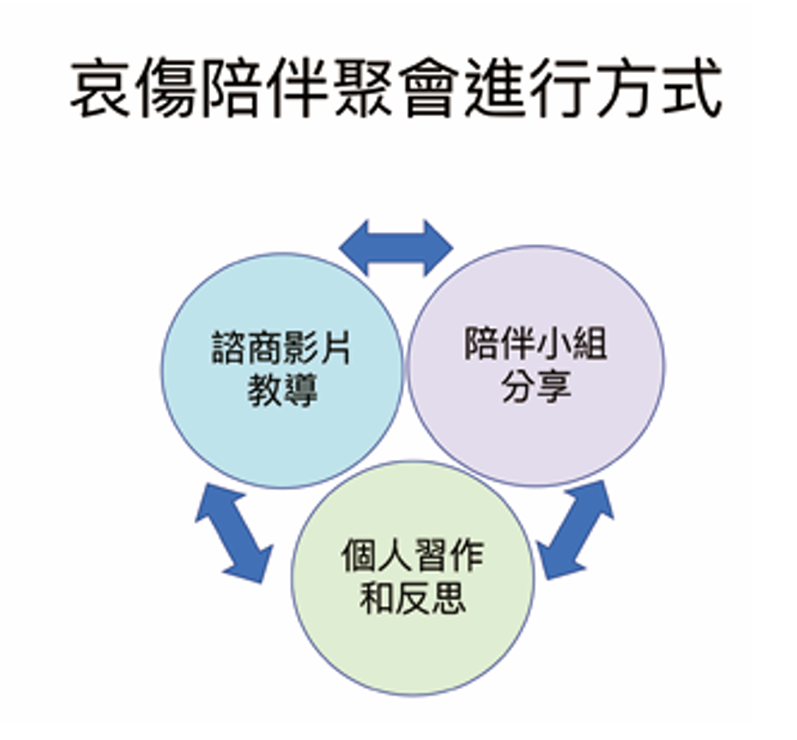
The three core components are closely interconnected, guiding participants to explore their own grief and delve deeply into various topics related to grief, such as: the pain of losing loved ones; facing changes and the challenges of rebuilding a new life; and seeking paths toward healing and peace.
At the start of the first session, there were ten team members serving as companions, half of whom had personally experienced the grief of losing loved ones, while the others were caregivers from Stephen Ministry. Thank the Lord, over the past year and a half, the team has grown to 13 members, including some who had previously participated in the course. They received training and became official companion team members.
Thanks to the convenience of online meetings, we have been able to connect with participants from all over the United States and establish ties with churches in different locations. These opportunities have become a network for future Chinese churches to launch grief support seed ministries and caring ministries. We firmly believe that each person’s story is unique and valuable, and we are confident that those who have been wounded and received healing can become the best comforters for others—just like Father Henri J. M. Nouwen’s book, The Wounded Healer.
Mending the Broken
A non-Christian participant, shortly after her husband passed away, found our support group through the GriefShare website. After the course ended, she invited me to appreciate an artwork that represented her inner emotions. Thus, in the summer of 2022, I went with her and another friend who had also lost a spouse to the art museum.
The artwork was a table. From a distance, it looked old and ordinary, but upon closer inspection, the table was covered with cracks and holes, as if pieced together from countless fragments, with some parts broken and incomplete. The entire table appeared very fragile, as if it could collapse and shatter at any moment.
The artist shared in an interview that the inspiration for this piece came from her experiences in Colombia, South America, where she encountered many women who had been harmed by violence. The healing process after such trauma was extremely difficult. However, she also mentioned that after enduring pain and brokenness, people are able, with extraordinary resilience beyond their capabilities, to rebuild lives that were once shattered.

(Image Source:https://commons.wikimedia.org/wiki/File:Kintugi.jpg)

As Christians, we know that the power to heal comes from God’s active grace and our trust in Him. When we bring the broken pieces of our hearts before God, His healing power can reshape a new and different life out of the brokenness.
That summer, three women in pain sat in the atrium of the art museum, feeling the Spirit of God washing and healing them through tears—slowly, steadily, and continuously.

In my experience of accompanying those who grieve, I have observed and reflected:
1. For some bereaved families, integrating local church resources with grief support is very helpful. For example, widowed grief survivors who immediately join a grief support group after their spouse’s passing, we collaborate with their local church to mutually provide appropriate support, such as offering food and practical companionship. This integration of church resources and grief support groups is a beautiful testimony.
2. Holistic care is also a key focus of support. In addition to emotional support, emphasis is also placed on addressing legal and practical life challenges, such as applying for social security benefits, as well as tax and financial planning. The aim is to understand the confusion and helplessness faced by the grieving individuals and to appropriately provide guidance and resources to help them make wise decisions while dealing with numerous complicated administrative matters amidst intense emotions.
3. The impact of suicide on families is an area that our coworkers are less familiar with and find difficult to handle. However, it is an unavoidable issue in today’s society, especially for parents who have lost young children. This type of grief carries a unique complexity, often accompanied by guilt, confusion, and a variety of conflicting emotions. As a church and support group, we still have much to learn and need to build a more comprehensive support system in order to truly provide appropriate care for these families.
4. The church has many areas to learn and grow in when it comes to accompanying those who have lost loved ones. By gaining a deeper understanding of the grieving process, providing emotional support, practical guidance, and assistance, the church can build a support system while continuing to learn and grow. This requires focused teaching and training in this area so that both the church as a whole and individual brothers and sisters can become channels through which the grieving find comfort and come to know God’s power.
5. Serving as a helper in a grief support group brings both joy and significant challenges. Each week, we encounter different stories of grief, facing various situations and personalities among the participants. Yet as helpers, what matters most is our willingness to listen and understand others’ pain, offering support with sincerity and empathy. We hope God grants us sufficient compassion and mercy, expanding the boundaries of our hearts so that we can enter into others’ sorrow and walk alongside them through their journey.
6. The development of the Chinese-language grief support ministry is a wonderful work of God’s guidance and leading; all we can do is remain humble and grateful. Through this, we have witnessed God’s love and grace, giving strength and comfort through the connection between people. We pray that God will enable this ministry to provide support and hope to more people in grief, and to become their guide and companion in rebuilding their lives.

Forked paths become the journey.
When I was young, I was full of hopeful plans for the future. But when I ended up at a fork in the road due to various circumstances, I tried hard to find my way back to the original path I had drawn. Yet now,I realized that a forked path itself is a journey—not merely a temporary detour or a permanent dead end; it may also be God’s way of arranging a different route, paving a new road altogether.In life, loss is inevitable. It is precisely these hardships that cause us to pause, to face the journey at the crossroads, to see how the Lord leads us, and to walk closely with Him.
Life often becomes a three-dimensional experience of faith through the pain of grief. Hebrews 6:19 says:「I have this hope as an anchor for the soul, firm and secure.」 Sometimes, this lamp of hope seems faint and dim, but when we hold tightly to hope and promises, its light can penetrate the storm and guide us forward. For me, that is enough.
In the past few years, our family has traveled a winding path, one that will never return to the smooth perfection I once hoped for, because some losses are irreplaceable, and some changes irreversible. What I do know is that I am walking a spiritual journey side by side with God. The winding path is just a part of the journey, not the destination.
It has been seven years since I lost my husband and began writing this piece. Through participating in the grief support group, I have witnessed the transformative power of this ministry. As I embraced the shadows and walked alongside those broken by sorrow, I noticed a faint light shining in the darkness. Augustine said that people cannot look directly at the sun but can see where the sunlight falls. Philip Yancey, in his memoir Where the Light Fell, wrote: “Sometimes, you need to see where the light fell, instead of the sun.”
You may not fully understand the entire journey or the purpose of the winding path, but you can see where the light falls, and in the place illuminated by the sunlight, catch a glimpse of healing and hope.
For me, the Mandarin grief support ministry is that place illuminated by the bright light. When the sunlight falls on the path—even if it is a detour—it unexpectedly leads to a hopeful way forward.
If you would like to learn more about grief support, please contact us by email at:GS************@***il.com.
Chyong-yi Wu,is originally from Taiwan. She and her husband lived in Texas and Massachusetts for many years, and she now resides in Maryland. She previously worked in university-based biological science research for many years and is currently employed by the federal government. At the same time, she is actively involved in young adult ministry at her church.