
Leading Teams — Encouraging Others to Grow
In the previous article, I encouraged ambitious professionals to move from efficiency to effectiveness, from focusing on themselves to investing in their teams, and from stress to joy. The goal was to help people discover meaning and motivation in both their work and their lives. As we progress through this stage and become outstanding employees, we are often promoted into leadership roles. But with that promotion comes a new set of challenges. We are no longer responsible only for doing our own work well; we must also find ways to help others do their work well. That is when we discover that leading people and managing a team is far more difficult than managing ourselves.
Because supervisors usually have more experience, they often assume they know better than frontline employees and naturally hope that their staff will follow their ideas and recommendations. In reality, however, employees may not act on that advice even after listening to it.
Being human is not easy. Whether we are supervisors or employees, it is worth asking ourselves: Am I willing to listen to the advice of others? If not, why not?
Why Do People Ignore Advice?
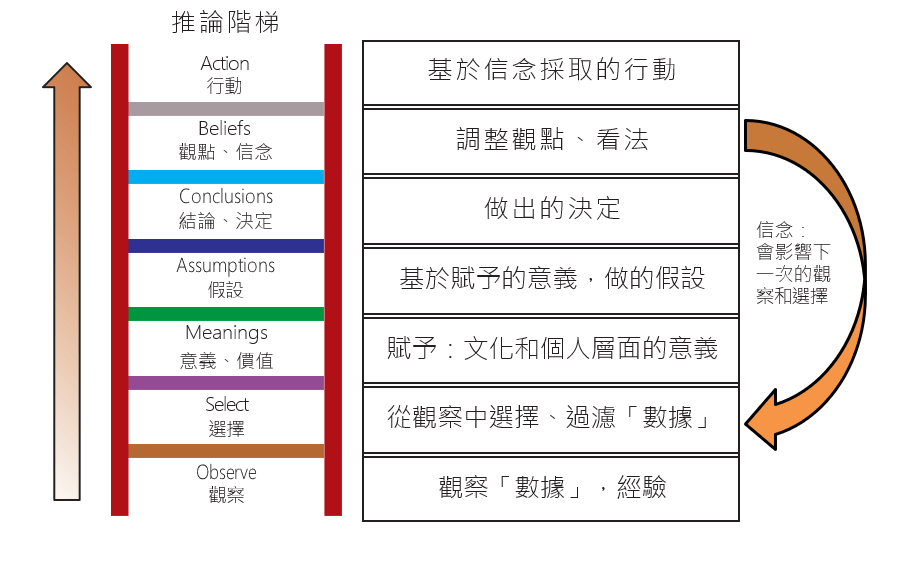
One frustration many leaders experience is this: “The solution seems so simple. If this person would just follow my line of thinking, the problem could be resolved easily. Why won’t they listen?” Chris Argyris, the Harvard professor and management scholar, developed the concept of the Ladder of Inference (Figure 1) to explain how people move step by step from observed facts and data, combine them with their own experiences, selectively assign meaning, make assumptions, draw conclusions, and then make decisions. The resulting viewpoints and beliefs, in turn, become the basis for future actions. This framework can help us examine our own thinking processes and the logic behind our reasoning.
To help a team grow, leaders need to recognize the unique value and strengths of each team member. Most of us assume that our judgments—including our evaluations of those who work under us—are objective and free from bias. In reality, however, that is seldom the case.
For example, a manager may notice that a team member is conscientious in her work and conclude that she is trustworthy, without realizing that this assessment is based on a filtered interpretation of the facts. The employee arrives at work on time and completes her assignments as scheduled. The manager then elevates these observations into matters of meaning and value, making the assumption: “This employee is capable and can be trusted.” Based on this belief, the manager entrusts her with even more responsibilities.
Suppose a manager hears some negative comments about an employee and begins to have doubts. Even if the employee's performance remains unchanged, the manager may unconsciously filter out much of the positive information and focus instead on the areas that are less than perfect. At the same time, the manager elevates these observations to the level of personal and cultural meaning, making the assumption that although the employee appears competent on the surface, he or she may not actually handle things reliably and therefore cannot be fully trusted.
As a result, when our relationship with a colleague or supervisor is good, they are more likely to view our actions positively. When the relationship is strained, however, no matter how hard we try, they may still find fault with what we do.
This reflects the concept of the Ladder of Inference: the “facts” people see are unconsciously filtered through various viewpoints and beliefs. Assumptions built upon those filtered facts inevitably drift away from reality and often carry elements of bias and prejudice. Once we understand the Ladder of Inference, it becomes easier to see why people can have completely different reactions to the same capable and principled individual. It also helps explain why some people fail to appreciate our achievements or the advice we offer.
People or Tasks?
When managers prioritize relationships with their employees, they are often willing to give them another chance even when mistakes are made. As a result, the relationship can enter a positive cycle. The Ladder of Inference reminds us that one reason we often find it difficult to encourage others is that we view them through a negative filter, seeing more of their weaknesses than their strengths. To correct this bias, managers need to intentionally cultivate values that focus on developing and encouraging people. They must learn to view their employees through a positive lens, helping them improve and grow. Only then can trust be built.

The key to leading a team is becoming an encourager who helps build up the lives of others. When employees understand that their manager's goal is not to control them, but to develop and empower them so that they can fulfill their own calling and potential, they are far more likely to open up and listen to advice.
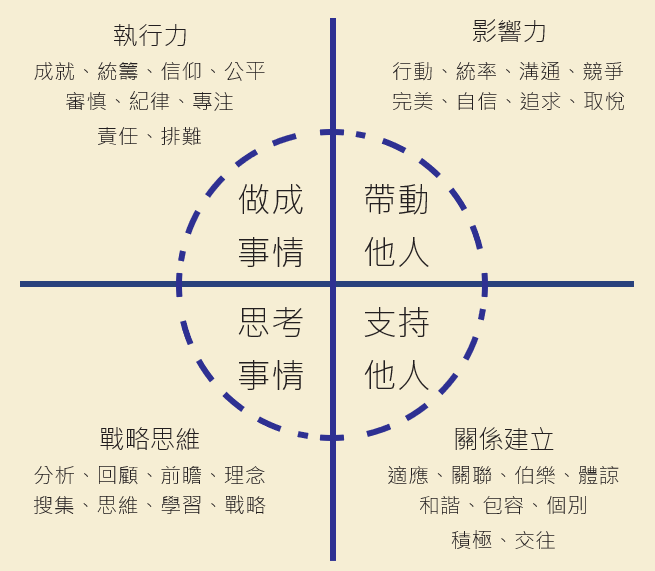
Gallup, the well-known American research and consulting organization, developed the CliftonStrengths assessment, which groups human talents into four domains (Figure 2). The domains on the left focus primarily on task accomplishment, including Executing (how work gets done) and Strategic Thinking (how people think about and analyze situations). The domains on the right are more relational in nature, focusing on Influencing and Relationship Building—how people impact, support, and connect with others.
After being promoted to a leadership role, many managers unknowingly fall back on their old way of working—relying on their own professional expertise while neglecting to build relationships with their team members. In reality, when trust and encouragement are lacking between supervisors and employees, staff members may lose confidence and motivation. Their performance can gradually decline, ultimately reducing the effectiveness of the entire team. Even highly capable employees will be unable to perform at their full potential if they have a poor relationship with their manager.
Gallup’s four-domain framework provides a clear direction for leaders. Managers must not only focus on planning and accomplishing tasks, but also place great importance on relationships with their team members. In team leadership, the focus needs to shift from caring for tasks to caring for people. Leaders should invest time in thinking about how to develop, encourage, and build up the members of their team. Only when strong relationships are established can the team function at its best and achieve lasting success.
Discover Your Strengths and Lead at the Right Time
Another important aspect of team management is leading at the right time and in the right way—an approach known as Situational Leadership (Figure 3).
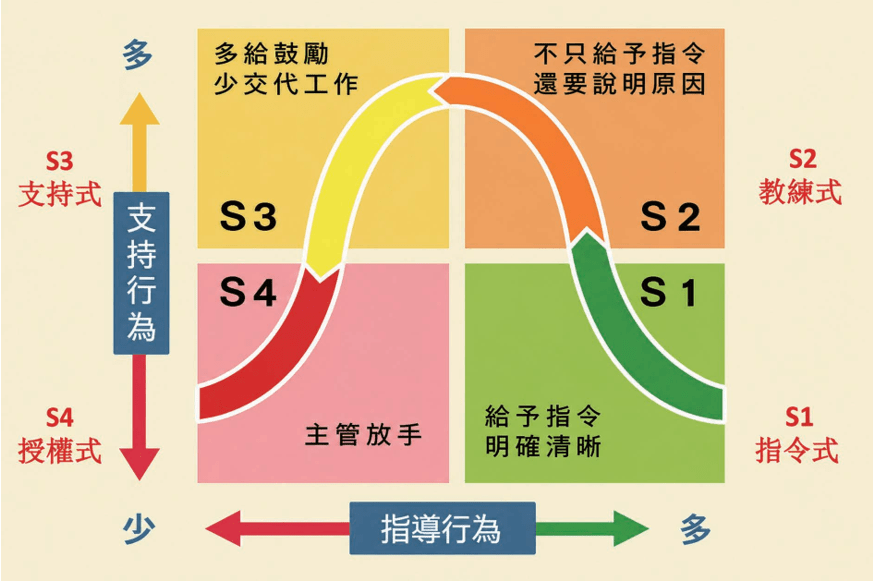
The Situational Leadership model divides the team-development process into four stages (S1, S2, S3, and S4) based on employees’ levels of competence. Each stage requires a different leadership focus. These four stages do not necessarily occur in a fixed sequence; rather, the appropriate leadership style depends on the relationship and level of trust between the leader and the follower, as well as the follower’s willingness, development, and progress. More specifically:
→ Stage S1: Employees are at a relatively early stage of competence. Leaders need to provide clear and specific instructions, offering a high level of direction and a lower level of support.
→ Stage S2: As employees become more capable, they need to understand not only how to do something, but also why it should be done that way. In addition to providing clear direction, managers should take on the role of a coach, helping employees discover and develop their potential. They should also provide greater support by considering what resources employees need to accomplish their work and how they can collaborate with others to achieve better results.
→ Stage S3: Employees are relatively independent. At this stage, managers gradually reduce the amount of direct instruction they provide, while continuing to offer a high level of support. Employees are now capable of thinking independently, so the leader’s role shifts toward encouragement and support, building trust and collaboration, and further developing the employee’s potential.
→ Stage S4: Experienced employees should be given greater autonomy and authority. Excessive intervention at this stage can be counterproductive. Leaders need to move from a supporting role to an empowering one, entrusting mature employees with greater responsibility and allowing them to maximize their potential.

As team members grow in competence, leadership styles must also evolve—from providing clear direction, to coaching, to supporting, and ultimately to delegating. In this way, the strength and effectiveness of the team can continue to grow.
The core task of management is not merely to get things done, but to develop people well. Effective leaders understand their role clearly and remain attentive to the demands of each situation, adjusting their approach according to the needs and development of their team members. When this happens, the relationship between managers and employees can grow from a short-term working partnership into a long-term collaborative one—from colleagues who simply complete projects together to a team that moves forward together toward a shared goal.
Knowing Yourself Through Conflict
The book of Job says that “man is born to trouble as surely as sparks fly upward.” Sooner or later, everyone encounters difficulties in work and life—challenges that flare up like flying sparks. If these “sparks” are handled poorly, they will inevitably burn and wound us. But if they are handled well, they may become shining opportunities that uncover strengths and potential we never knew we had.
Leaders must contend with both technical challenges at work and the challenge of managing their own emotions. You may already have discovered that the emotional health of individuals and teams directly affects business performance. Once you step into a management role, you need to keep learning—learning how to help your team reduce conflict and build relationships of mutual trust.
As discussed in the previous article on the Johari Window, leaders should practice intentional self-disclosure by appropriately sharing aspects of their personal situation so that team members can understand them more deeply. Leaders should also actively seek feedback, inviting others to point out their blind spots. Through self-disclosure and feedback, the “open area” can be expanded, allowing others to better understand our behavior and intentions, thereby reducing misunderstandings and conflict. In this way, trust and mutual understanding within the team can grow, enabling the team to find opportunities for growth even amid tension and setbacks.
Conflict is inevitable in human relationships. At its root, conflict often arises from a gap between our inner needs and our expectations. Understanding these needs and expectations can help us relate to others more effectively. The Johari Window reminds us that while seeking to understand others, we must also seek to understand ourselves. When we find it difficult to work with someone, could it be that some of our own needs are not being met? When we argue with another person, what is it that we really want?
For example, when I am upset because of conflict with one of my children, I may find myself thinking at work that my colleagues cannot do anything right. In reality, there is nothing wrong with my colleagues. Rather, the conflict with my child has generated negative emotions within me, leaving me feeling misunderstood. I then project those feelings onto my relationships at work and begin to believe that my colleagues do not understand me either. At that moment, my real need is not for my colleagues to complete a particular task, but to feel understood.
When conflict arises, a manager's task is not to overpower the other person, but to look inward and identify the issues that are causing confusion or frustration. After addressing those issues, the manager can return and communicate more effectively with colleagues and team members. Likewise, when a colleague or employee appears to be the one who has “started the conflict,” managers need to understand that person's underlying needs. Only by understanding both our own needs and the needs of others can we work together more effectively.
When managers encounter conflict, they should not avoid it. Instead, they need to calmly examine both themselves and others more carefully, taking time to reflect and understand what is really happening. They should actively seek the opinions and feedback of others while also being appropriately open about their own thoughts and feelings. In doing so, they can identify blind spots and make meaningful improvements. As a result, potential that was previously hidden or underutilized can also be discovered and developed.
Leaders should also avoid pressuring employees to reveal their thoughts or forcing them to confront their blind spots. Instead, they must first cultivate a safe environment within the team—one in which people are willing to communicate openly and honestly of their own accord. The most effective approach is for leaders to lead by example. By being the first to share their genuine feelings and perspectives, they can invite team members to do the same. In this way, a healthy culture of open communication can gradually be established.
Servant Leadership
In the past, being “strong” was often considered an essential leadership trait, and leadership was commonly associated with giving orders and directing others. Modern management research, however, has found that Servant Leadership is often a more effective way for leaders to increase their influence.
What is Servant Leadership? It is a leadership approach in which leaders are willing to serve others with the heart and posture of a servant, placing the needs of their team members first. They support their employees' learning and growth, empower them through delegation, and place a high value on building strong relationships.
Servant Leadership is not primarily about how capable a leader is. Rather, it is about recognizing that even capable leaders are still people with weaknesses, and viewing both themselves and others through that lens. When people see that a leader is genuine and authentic, they become more willing to build relationships with that leader and even follow his or her leadership. This approach is effective not only in the workplace, but also in families, churches, and community service settings.
Brené Brown, a professor of social work at the University of Houston, delivered her famous 2010 TED Talk, The Power of Vulnerability, which became one of TED’s most popular presentations. She argues that vulnerability is not weakness but a normal part of the human condition. Only by acknowledging and revealing our vulnerabilities can we become authentic people. By honestly facing our inner struggles and accepting ourselves, we gain the courage to face reality. Her conclusion is simple yet powerful: Where there is struggle, there is hope. What makes us vulnerable can also make us strong.
In my own journey of growing as a leader, I have paid special attention to the power of vulnerability. Whenever I find myself losing my temper with others, I remind myself to acknowledge and accept my own weaknesses and vulnerabilities. In those moments, I am filled with deep gratitude, because even though I am far from perfect, my family and teammates still give me opportunities and continue to accept me. That realization gives me the courage to apologize, to seek reconciliation, and to deepen those relationships even further.
In the workplace, when leaders are willing to openly acknowledge their shortcomings, they communicate to the team that they, too, have vulnerabilities and need the support of others. By honestly facing the realities of their own lives, leaders are more likely to earn the trust and respect of their team members. When everyone feels free to be their authentic selves, leaders and team members can become a source of mutual encouragement, support, and strength. Together, they can face challenges and continue to grow.
Growth Mindset
Research by Carol Dweck, a professor at Stanford University, suggests that people generally operate from one of two mindsets. A fixed mindset is the belief that a person’s abilities are largely unchangeable—that intelligence, creativity, and talent are innate traits. In contrast, a growth mindset is the belief that abilities can be developed and that people have the capacity to learn, improve, and grow over time.
She believes that every person has the potential to grow. Whether or not that growth takes place, however, is ultimately a matter of personal choice.
Why do so many people choose not to grow? Human nature tends to seek comfort and avoid effort, while growth always comes at a cost. Those who are unwilling to pay that cost, or who fear the pain and inconvenience that change may bring, are likely to remain where they are. On the other hand, when people find fulfillment in growth itself, or when they are motivated by someone or something they deeply care about—their purpose and meaning in life—they become much more willing to pay the price that growth requires.
Professor Dweck also conducted brain-wave studies and found that people with a fixed mindset tend to show a relatively muted brain response when confronted with new problems, unfamiliar situations, or fresh challenges. In contrast, people with a growth mindset display much more active neural responses in such situations.
If we observe carefully, physically and emotionally healthy children tend to have a growth mindset. Although their physical abilities and knowledge are limited, they are not ashamed of that. They happily ask questions when they do not understand, learn when they do not know how to do something, and get back up and keep running when they fall. Sadly, many people lose this growth mindset. Their thinking becomes increasingly fixed, making it difficult for them to learn new knowledge and skills.
For workplace professionals, the challenges they face inevitably bring pain, and change is never easy. Let us remember: perfect love casts out fear! First, find the meaning and value of your own life, find the person or cause you love most deeply, find a goal worth striving for—then you will have both the willingness and the courage to pay the price, and become someone who keeps on growing.

Finding Joy in Failure
Failure can make us unhappy, yet we can still consciously seek out and create moments of joy within it.
I am a father of two young people. In the course of being with my children, I have experienced difficulties, but by viewing these failures as opportunities for growth, we have created ways of interacting that are joyful and meaningful.
I tell my children to see "making mistakes" as a "teammate" on life's training ground, rather than a "problem." When conflicts arise between my children and me, I explain: "Daddy ran into some difficulties at work today, so my emotions are a bit unsteady—please forgive me." I then explain the setbacks I encountered at work and the reasons behind my emotional instability, as well as how I've grown through these experiences. Many of the "failures" I've experienced in my relationship with my children have become stepping stones for growth, and through round after round of this kind of training, I've grown more and more seasoned. So my heart is filled with gratitude and joy. (Please refer to the article "Courage to Grow: Leaders Who Find Hope in the Midst of Setbacks" in Issue 66 of this magazine's Stewardship column.)
Common definitions of "mistakes" include—
- "I make a mistake"—I made a mistake, and it's fine once I correct it. This attitude treats the "mistake" as a "behavior"; the essence of "I" remains accepted, with an opportunity to make things right.
- "I am a mistake/loser"—I myself am a mistake or a failure. This attitude equates "I" with the mistake or failure itself; at its core, it is a fixed-mindset identity, one that easily forecloses the opportunity to grow.
My hope is that workplace professionals across every field and industry can come to see themselves this way: accepting that mistakes happen to them, knowing that they themselves are accepted, while also being willing to take action to correct the mistake and seize the chance to begin again. Even when facing setbacks or making mistakes, may they take the initiative to seek out friends and mentors around them, observing how those people, when facing problems of their own, turn experiences of failure into joyful learning. Little by little, over time, everyone has the potential to become a leader with a growth mindset—bringing blessing to both career and family life.
Leading a team is indeed not easy, but it is not the end point of one's career. In the next issue, let us reflect together on how to open up a new track for a "slash" career, transforming economic capital into social capital and passing on a sense of mission. (This article is excerpted from Workplace Habits of the Heart.)
Think and act:
- How would you apply what you've learned about the "Ladder of Inference" to avoid misunderstanding and bias when evaluating others?
- How do you understand "servant leadership"? How would you apply it in your workplace and life?
- Do you consider your own mindset to be "fixed" or "growth-oriented"? How does this shape the way you lead your team toward a growth mindset in the workplace?