
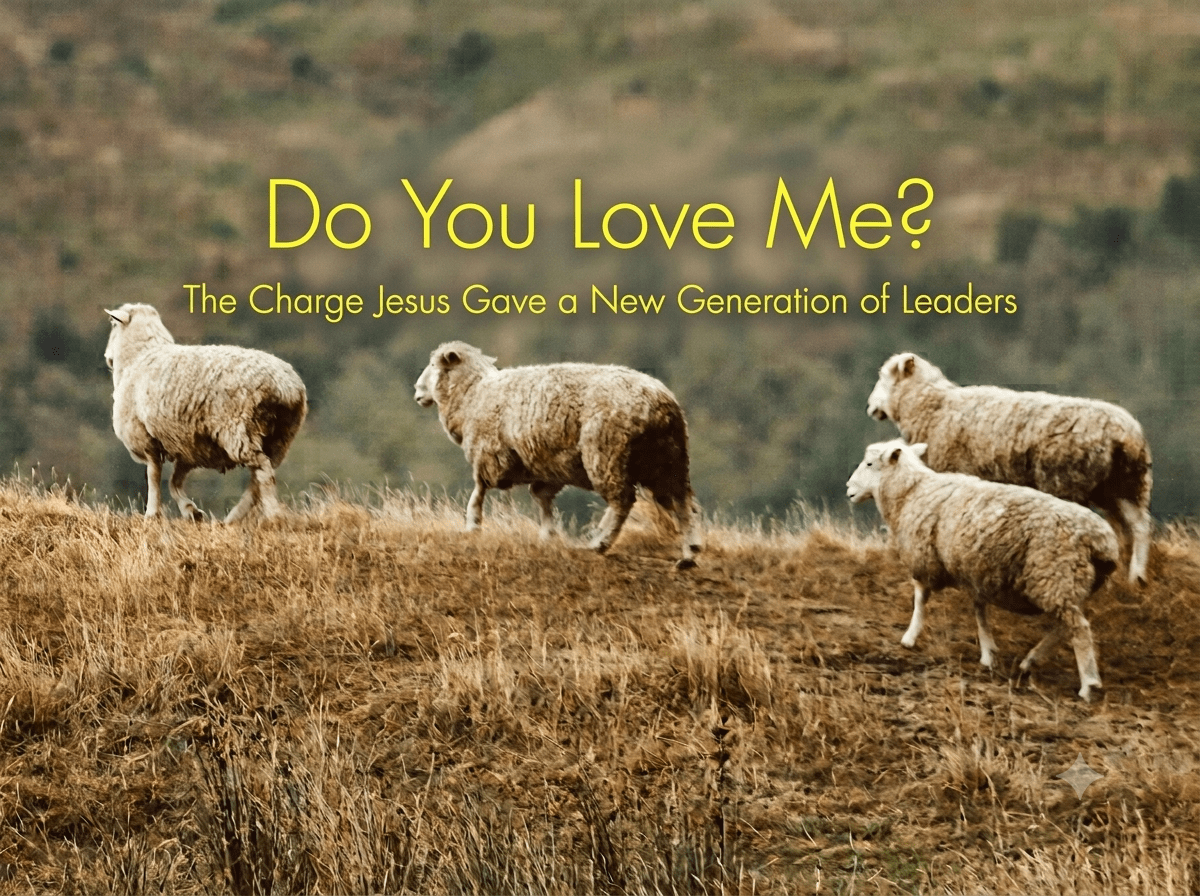
Do You Love Me? -- The Charge Jesus Gave a New Generation of Leaders
Jesus appeared to His disciples on the shore of Galilee after telling them to fish (see John 21:1-14). When the meal was finished, he asked Simon Peter:
“Simon, son of John, do you love Me more than these [fish]?”
Three times, Peter answers yes. And three times, Jesus gives the same commission back: feed My lambs, shepherd My sheep, feed My sheep.
This is the founding moment of the Church. Jesus is looking at a broken fisherman and saying: you are the one I am building my Church on. I want you to go and feed them.
Peter’s track record was not good, but Jesus asks about Peter’s love for Him, not his past performance. Jesus knew that love, not ambition, obligation, or religious duty, could sustain Peter. He is asking us the same question today.
The Threefold Reversal
In John 21, Jesus is actively restoring Peter. Peter had denied Jesus three times next to a charcoal fire in the high priest’s house (see John 18:18). Three denials. And then after the third time the rooster crowed. And Peter went out and wept bitterly.
Besides another charcoal fire, Jesus gave him three questions to restore Peter’s three denials. Jesus again commissions him.
Peter Denies (John 18)
17 “You aren’t one of this man’s disciples too, are you?” she asked Peter.
He replied, “I am not.” […]
25 Meanwhile, Simon Peter was still standing there warming himself. So they asked him, “You aren’t one of his disciples too, are you?”
He denied it, saying, “I am not.”
26 One of the high priest’s servants, a relative of the man whose ear Peter had cut off, challenged him, “Didn’t I see you with him in the garden?” 27 Again Peter denied it, and at that moment a rooster began to crow.
27 Again Peter denied it, and at that moment a rooster began to crow.
Jesus Restores (John 21)
15 […] Jesus said to Simon Peter, “Simon son of John, do you love me more than these?” “Yes, Lord,” he said, “you know that I love you.” Jesus said, “Feed my lambs.”
16 Again Jesus said, “Simon son of John, do you love me?” He answered, “Yes, Lord, you know that I love you.” Jesus said, “Take care of my sheep.”
17 The third time he said to him, “Simon son of John, do you love me?” Peter […] said, “Lord, you know all things; you know that I love you.” Jesus said, “Feed my sheep.”
The first two times, Jesus uses the word agape—total, unconditional, self-giving love. Peter answers with phileo—the word for deep personal affection, like love for a close friend. He did not dare to claim the higher word. He had already learned what happened when he tried to overclaim as he did when he said he would even go with Jesus to death (see Matthew 26:35).
And then the third time, Jesus meets him where he is. He uses phileo too. Not because the standard has lowered, but because Jesus is interested in the heart of the man standing in front of Him. He is saying: whatever love you have, give it. Start there.
This is the pattern of how Jesus commissions leaders. Not from a place of perfection, but from a place of honest, chastened, real love. Peter’s tears showed us that he was deeply sorrowed by his lack of willpower and strength to do the right thing and stand by the Lord in his final moments, but this time, the Lord was giving Peter His strength.
What It Means to Feed the Sheep
Jesus gives Peter three commands that form a picture of the full scope of pastoral care.
Feed My lambs. The lambs are the new believers, the young ones, the ones just coming to faith. They are fragile. They are easily confused. They need simple, nourishing truth—not complexity, not performance, not theological debate. Just truth, given with love.
Shepherd My sheep. The word here shifts. To shepherd is more than to feed. It means to guide, to protect, to go looking when one goes astray. It means staying present through difficulty, not just the easy seasons. A shepherd knows the terrain and knows the dangers and does not leave the sheep to figure it out alone. It means to disciple and train up.
Feed My sheep. And finally, the grown ones. The mature believers still need feeding. The Word of God does not become unnecessary once someone has walked with Jesus for twenty years. If anything, the need deepens. The shepherd’s table must remain set, and we must still eat the bread of life and drink the living water.
All three stages of a believer’s life—the new convert, the growing disciple, the seasoned saint—are to be cared for by the Church. This is what Jesus was entrusting to Peter. And it is what He entrusts to every generation of leaders that comes after.
This includes our generation. This includes our churches. This includes the leaders reading these words right now.
But First, Wait
Peter received the commission at the shore of Galilee, but he did not start preaching right away. Something else had to happen first. After John 21 comes Acts 1.
Do not leave Jerusalem, but wait for the gift my Father promised, which you have heard me speak about. For John baptized with water, but in a few days you will be baptized with the Holy Spirit. (Acts 1:4-5)
He tells them to wait. The disciples had just been given the Great Commission—be My witnesses to the ends of the earth—and Jesus’ immediate instruction was: do not move yet.
This matches what God tells us many times. He gives us a command, and we immediately want to set out and do it with our own strength, but many times He is asking us to wait until He sets up everything else too, so that we can be even more fruitful.
The disciples could have started immediately. They had been with Jesus for three years. They knew the stories, the parables, the teachings. They could have organized themselves, but human effort is not the same thing as Spirit-empowered ministry.
Peter, who denied Jesus three times, would go on to stand before thousands in Jerusalem and preach a sermon so penetrating that three thousand people were cut to the heart and baptized in a single day.
The Holy Spirit came..
When the day of Pentecost came, they were all together in one place. Suddenly a sound like the blowing of a violent wind came from heaven and filled the whole house where they were sitting. They saw what seemed to be tongues of fire that separated and came to rest on each of them. All of them were filled with the Holy Spirit and began to speak in other tongues as the Spirit enabled them. (Acts 2:1-4)
The fisherman who ran away from a servant girl became the preacher who stood up to declare judgment on thousands and said: “Therefore let all Israel be assured of this: God has made this Jesus, whom you crucified, both Lord and Messiah” (Acts 2:36). This was the work of the Holy Spirit.
The New Generation of Kingdom Leaders
In Acts 2, Peter quotes Joel:
In the last days, God says, I will pour out my Spirit on all people. Your sons and daughters will prophesy, your young men will see visions, your old men will dream dreams. (Acts 2:17)
This is the great reversal of Babel. In Genesis 11, God scattered the nations and divided their languages because they were building toward heaven by their own power and ambition. Now, at Pentecost, the Spirit falls on people from every nation under heaven, and they all hear the wonders of God in their own tongue.
And this is still happening. In Iran today, thousands of mosques have closed, and the Church is growing faster than at perhaps any other time in history. In China, where the ancient emperor once worshiped Shang Di (the Most High God), believers are multiplying. In Bangladesh, in Nepal, in the least-reached places on earth, the Holy Spirit is moving because there are people who waited and prayed, who received the commission, and who obeyed the Holy Spirit.
The call comes to us the same way it came to Peter. Not because we are the most qualified. Not because our track record is there. But because Jesus asks us one question: do you love Me? If the answer is yes, even a trembling yes, even a phileo when He asked for agape, the commission is clear. Feed My lambs. Shepherd My sheep. Feed My sheep.
How to Carry the Commission
So what does this mean for us—for the Church, for leaders in our community, for those who feel called but are uncertain?
It means we must ask the question Peter was asked: Do I love Jesus enough to set down whatever I am currently fishing for—my career, my comfort, my status—and go out to preach the gospel?
It means we must learn to wait, prayerfully and expectantly. The disciples came together, and they prayed constantly (see Acts 1:14).
Every disciple received the tongues of fire. The Spirit was poured out on all of them. Some were called to the Jerusalem of their own household. Some were called to the Judea of their local church. Some were called to the Samaria of the unfamiliar. And some were called to the ends of the earth, places where the gospel had not yet reached.
The Question is Still Hanging in the Air
Jesus asks us the same question as He asks Peter.
We are not the most theologically trained, the eldest, or the most experienced. He is asking the ones who tried to do it with their own strength, wept bitterly, and came back. He is asking the ones who have failed and been restored. I wanted to be used by God so much and ended up in a works-based church and bitterly left. He now is asking me and you, ordinary people, because honestly, we know we cannot walk away from the Lord of love. We know He alone has the truth.
Lord, you know all things; you know that I love you. (John 21:17)
Hear His commission. Feed My lambs. Shepherd My sheep. Feed My sheep.
And while we are still gathering our courage together, wait in prayer. Wait on God’s timing and the Holy Spirit. Then nothing will be impossible.
About the Author

Lilia Tse is a Barnard College graduate, former digital media professional, and former co-founder of Adfire Health.
A stay-at-home mom, TikTok creator @angelxic, and faith leader—including youth leader of Gospel Camp and President of Word of Life Bangladesh.
she shares the gospel of Christ and inspires meaningful connections through digital media.